Translate

Showing posts with label David Cronenberg. Show all posts

Monday, November 25, 2013

The Dead Zone (1983)

Christopher Walken wakes from a coma due to a car accident, only to find he has lost five years of his life, and yet gained psychic powers. Foreseeing the future appears to be a 'gift' at first, but ends up causing problems...

The Dead Zone is a 1983 American horror thriller film based on the Stephen King novel of the same name. Directed by David Cronenberg, the film stars Christopher Walken, Martin Sheen, Brooke Adams, Herbert Lom and Tom Skerritt.  In the previous post I commented on a movie based on a Stephen King story and it got a thumbs down.  This movie gets two thumbs up....way up. It might be the best adaptation of a King story ever made.  It's one of the few King novels turned into a really good movie.

The film centers around a young man (Christopher Walken) who is a popular teacher, has a great girlfriend he's going to marry, and has a fantastic life and future in front of him.  But late one night, a horrific car accident takes all of that away from him.  He awakens from a coma five years later and his old girlfriend is married with a child and he has a new ability.  He's able to look into the past or the future with just a touch.  A terrible doomsday vision affects him and he sets out to change the future, even if it means he will not live to see it for himself.

Your house is burning! There's still time!
 This is an emotional, sorrowful tale of loss, grief and sacrifice.  Walken is absolutely fantastic in the role.  He's very likable and, at the same time, frighteningly intense.  The wintry backdrop makes for a bleak atmosphere and helps convey the sadness and loneliness that Johnny feels in his life.  Also starring are Brooke Adams as Johnny's ex, and Herbert Lom as a doctor.  I kept waiting for Lom to go on a rant about Inspector Clouseau.  Martin Sheen is impressive as a sinister politician

Director David Cronenberg delivers a film that resonates perfectly with King's book.  With Cronenberg you may expect this to be a gore-filled affair, but it is actually a subtle film which stresses the psychological sense of fear rather than settling for blood-spattered mayhem.  Nothing in this film will make you jump out of your seat in terror.  But it will wear on your mind and stick with you long after you've finishing watching it. 

it's called the coma diet - lose weight while ya sleep
This film holds up today even though it was made in 1983.  The Dead Zone's script was written by the very talented Jeff Boam and it's fantastic.  He had a nearly unbroken nine-year streak of hit screenplays.  A somber, downbeat film with an unhappy and reluctant hero, The Dead Zone is compelling and definitely recommended.  Quite possibly my favorite film from Cronenberg.

Trivia: 

Before the accident, Johnny instructs his class to read "The Legend of Sleepy Hollow". Christopher Walken would later go on to appear in Tim Burton's Sleepy Hollow.

Martin Sheen's character says he has had a vision that he will be the President of the United States. Sheen went on to play the President of the United States in the mini series Kennedy and in The West Wing. 

During the time Michael Kamen was composing the music for the film in London, he would play the score on the piano in his home. He received several complaints by his neighbors who asked, "Can you please stop playing that music? I can't sleep and it's giving my family nightmares."

The film makes reference to 'Sleepy Hollow' which, like this film, is about a schoolteacher. In the novel, Johnny Smith compares his coma and subsequent recovery to 'Rip Van Winkle,' another short story written by Washington Irving. 

"Bless me"? Do you know what God did for me? He threw an 18-wheeled truck at me and bounced me into nowhere for five years! When I woke up, my girl was gone, my job was gone, my legs are just about useless... Blessed me? God's been a real sport to me!
Director David Cronenberg had to re-shoot the scene in which John Smith has his first premonition. It showed a little girl's room burning and a small E.T. doll could be seen on one of the shelves. The scene had to be re-shot when Universal Pictures threatened to sue.

Cronenberg fired a .357 Magnum loaded with blanks just off camera to make Smith's flinches seem more involuntary; this was Christopher Walken's own idea. 

A stuntman was severely burned around the legs and groin when a squib went off too near him during the shooting of the WWII flashback sequence.

The "sweat" on Christopher Walken's face during the "burning bedroom" sequence was in fact a flame-retardant chemical that had been sprayed onto him. The resulting effect, which hadn't been anticipated, looked surprisingly dramatic on film. 

David Cronenberg wanted to change the name of Christopher Walken's character: "I'd never name someone 'Johnny Smith'", he quipped, but in the end it was left as is. The book does specifically mention how it sounds like a fake name.

One of only three David Cronenberg films that do not have a score by his friend, composer Howard Shore. This was due to studio politics in which Paramount wanted a more familiar composer to write the music for the film. Michael Kamen, who had written the music for the film Venom for the studio, was chosen instead. 


This film (and Stephen King's novel) are both loosely based upon the life of famous psychic Peter Hurkos. Hurkos claimed to have acquired his alleged powers after falling off a ladder and hitting his head.

The poem Johnny reads in the beginning of the film is the end of "The Raven" by Edgar Allan Poe. 

There are several deleted scenes that were filmed and completed but have never been seen publicly and are thought to have been discarded prior to the films release. Among them: - A prologue showing John Smith as a boy (played by Stephen Flynn) who sustains a head injury during an ice hockey match. The scene features actor Sean Sullivan as John's father. - An alternate scene of John Smith's vision of the Camp David scene (featuring Martin Sheen) in which John himself appears in the vision as a helpless spectator. Photos of these scenes appeared in the December 1983 issue of Cinefantastique.

Three people were involved in the James Bond franchise. Anthony Zerbe (Roger Stuart) would later appear in Licence to Kill, while Christopher Walken (Johnny Smith) would later appear in A View to a Kill. Michael Kamen, who did the music for this film, would later do the music for Licence to Kill. 

The Dead Zone was the first of several Stephen King novels and short stories that took place in the small town of Castle Rock. Others include Stand by Me, Cujo, The Dark Half, and Needful Things.

Bill Murray was Stephen King's choice for the part of Johnny.

The gazebo where the murder took place was built for the film, and was later donated to the town of Niagara-on-the-Lake, Ontario, where it was filmed and is now a favourite spot for wedding photographs.

I have had a vision that I am going to be President of the United States someday. And nobody, and I mean *nobody* is going to stop me!
In the "nuclear war" scene, Greg Stillson, Martin Sheen's character, threatens to "hack off" someone's hand and put it on the scanning screen. An earlier version of the script actually had Stillson shooting the man and putting his dead hand on the screen.

One rejected ending had Johnny Smith survive being gunned down and predicting a knife attack against his girlfriend while in the hospital, then slipping back into a coma and dying.

In the final scene when Sarah is crying and hugging Johnny, we hear her stop crying for a few seconds to tell Johnny that she loves him, but since her mouth is obscured we don't actually see her say it. The original script did not have her saying this. Her voice was dubbed in later in order to have some closure for Johnny.

The Ice is going to BREAK!!!

Thursday, November 14, 2013

The Brood (1979)

A man tries to uncover an unconventional psychologist's therapy techniques on his institutionalized wife, while a series of brutal attacks committed by a brood of mutant children coincides with the husband's investigation. 

The Brood is a 1979 science fiction horror film written and directed by David Cronenberg, starring Oliver Reed, Samantha Eggar, and Art Hindle.  Another brilliant early David Cronenberg horror film, subtly stuffed with sexual obsessions and social criticism.  Cronenberg's own and intelligently written script once again focuses on humans' defining "inner-evil" and blends real-life issues like child abuse and psychiatric patients with adorable low-budget horror topics such as mad scientists and eerie mutant killers.  It has some moments that will stick with you for a while.

The plot in a nutshell - In the care of an eccentric therapist (Oliver Reed), a woman (Samantha Eggar) undergoes an experimental form of anger management; while parallel to her treatment are a serious of bizarre and questionable murders. At the heart of the story is her husband (Art Hindle), who is in desperate search of the truth behind the strange goings on.

The Brood is an examination of emotions (rage in particular)
 The performances are excellent. The late Oliver Reed is splendidly sinister as the odd psychotherapist. Samantha Eggar does a haunting performance as the disturbed mother of 'the brood'. Art Hindle is good as always as Eggar's understandably worried husband. The supporting cast is also good.

The story is told in a very classical sense, almost like Poe with a slow beginning, a sense of doubt and confusion in the middle, and a shocker and a kicker of an ending.  Cronenberg's direction is well-polished creating a haunting atmosphere and the special makeup FX are unforgettably good. The violence however is occasionally graphic so it's not for all tastes. In short, The Brood isn't for the squeamish. The eerie musical score by Howard Shore creates an extra degree of tension to the unfolding events.


The Brood is scary and disturbing and should be seen by all horror film fans. I find it to be a sadly neglected classic. It's certainly a frightening journey that won't be forgotten. One of Cronenberg's greatest films!

These kids don't play nice.
Trivia:

David Cronenberg wrote the film following the tumultuous divorce and child-custody battle he waged against Margaret Hindson. Cronenberg also said that Samantha Eggar's character, Nola Carveth, possessed some of the characteristics of his ex-wife.

This film is one of the last mediums through which to see the interior of the old Toronto Police Headquarters on 590 Jarvis Street in Toronto, as the Headquarters was re-located to a new building in 1988 and the older building (shown in the film) was torn down to make room for condominiums in 2007. 

Tuesday, November 12, 2013

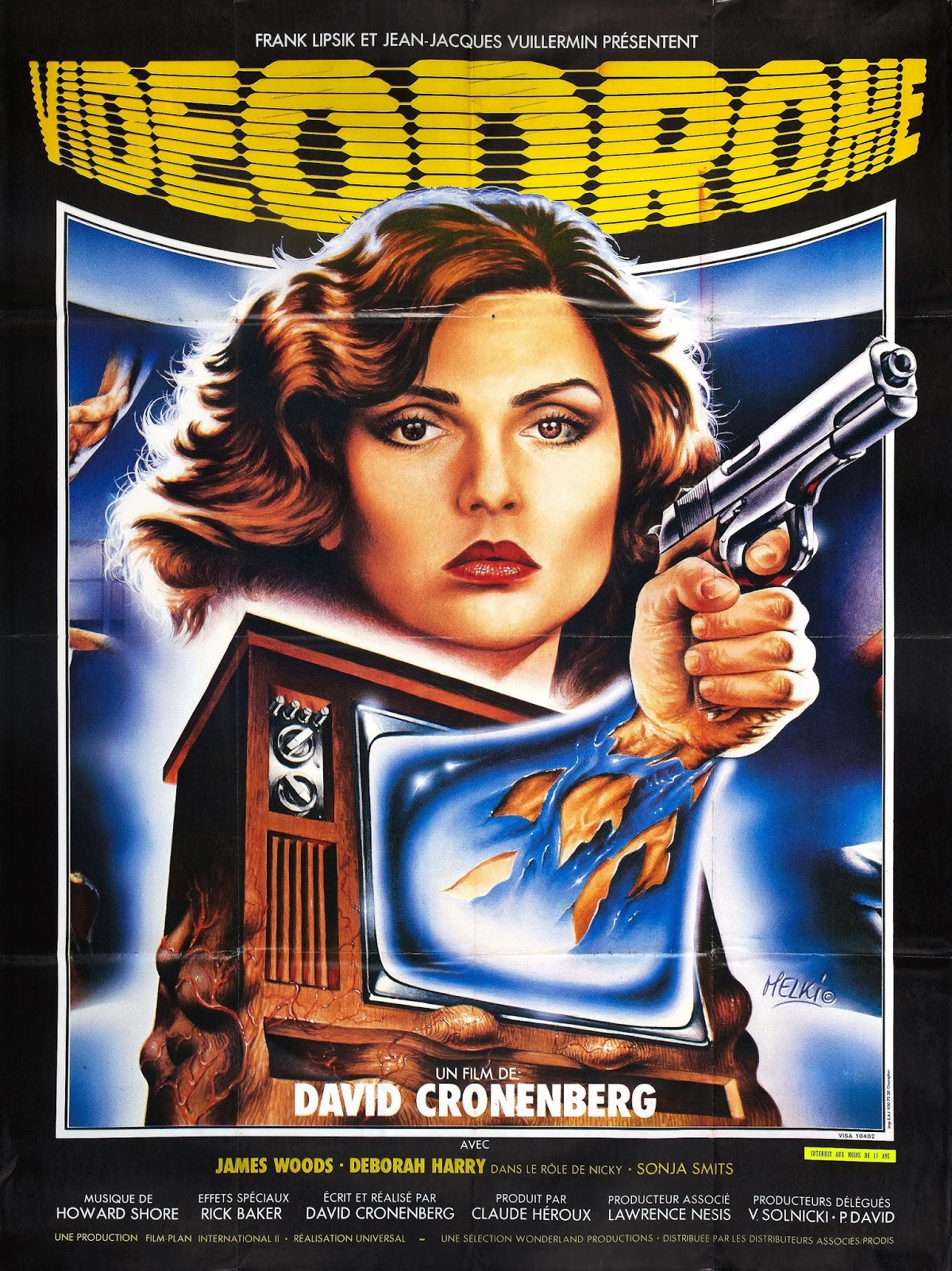
Videodrome (1983)

Max Renn runs a TV channel, and when looking for new material to show--he discovers "Videodrome." His girlfriend, Nicki Brand, goes to audition for the show, and Max gets drawn into the underlying plot that uses the show as its front for a global conspiracy.

Videodrome is a 1983 Canadian science fiction horror film written and directed by David Cronenberg, starring James Woods, Sonja Smits, and Deborah Harry.  David Cronenberg has given us lots of films that range from the bizarre to the slightly less bizarre to the stupefying.  This movie was Cronenberg's first masterpiece in my opinion.  The film was Cronenberg's vision of our relationship with TV and manages to repulse and intrigue simultaneously.

DO NOT change that dial
Just about everything works with this film.  The acting, even by Debbie Harry in her first starring role, is excellent. James Woods, in particular, excels.  He really does a great job becoming the sleezy Renn.
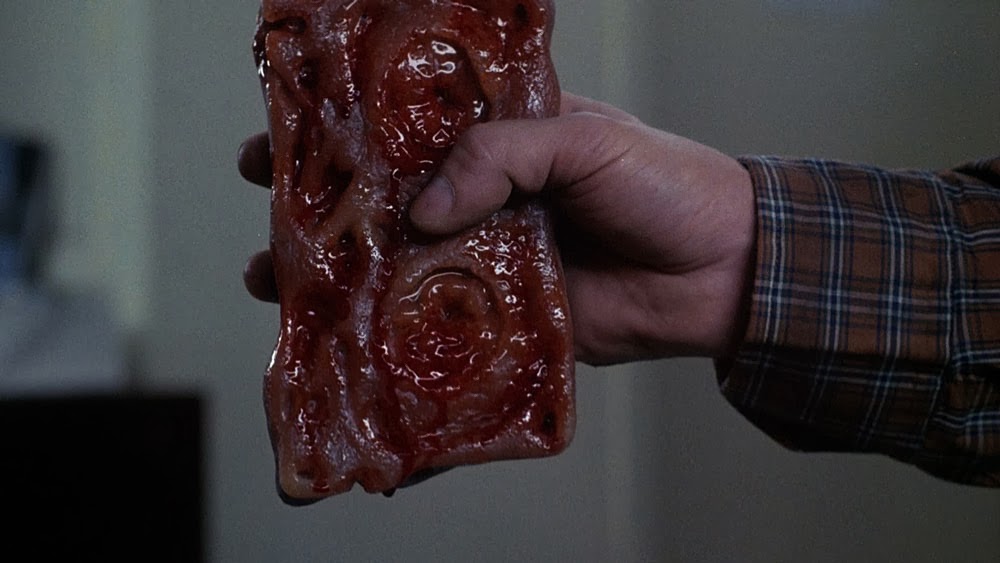
Woods disbelief graduating into terror graduating into acceptance is the rock upon which Videodrome rests.  The set pieces are good and the special effects are pretty damn awesome for 1983.  Music is another key element at work.  The score by Howard Shore swells up during the film's most intense and surreal moments, the best is during Woods's lovemaking with his television.  Yeah you read that last line correctly.
Hey dude....I got a great videotape for you to watch.
Let's bounce back to Miss Harry and her role for just a second.  Her character is into some weird sexual shit.  She enjoys cutting herself for pleasure and having her lover stick things through her earlobes while banging.  Oh and for fun she burns her chest with a lit cigarette. The character has a smaller role in the film but as you can see, it's memorable. No heart of glass with her.  The tide is not high here son.  Ok...they're super weak Blondie jokes but I had to throw it in.

When you bang a chick and she starts burning her chest with cigarettes....it's time to punt son.
Videodrome is a movie that was ahead of its time.  The innovative mix of science fiction, sex, violence, surrealism and horror has lost none of its punch over the years.  I'm limited from going into much detail on the plot and events as the spoilers could ruin the film should you decide to watch it.  It's a good little film to check out.  Long live the new flesh.

Trivia:

David Tsubouchi, who appears here briefly as a Japanese porn dealer, later became a Minister in the Ontario provincial government. His appearance in this controversial film as a pornographer was exploited by the opposition.

Among the scenes that were scripted but deleted was one where Max Renn's TV rises up out of his bathtub, while showing an image. The crew had researched how to do this - there had been talk of having the actor IN the tub - and had come up with several solutions. One involved filling the tub with a clear fluid that was non conductive, but that would have cost $25 a quart. The crew eventually decided to take a real TV and simply cover its insides with layers of waterproofing insulation. It worked - they dunked the TV into a swimming pool and found, to their astonishment, that TVs float due to the ultra-high vacuum inside the picture tube. The scene was axed just before it was to be filmed.

During filming of the Cathode Ray mission sequence, the film's gaffer, Jock Brandis, walked in and casually informed the crew that the power lines to the building were smoking because of the load imposed on them by the TV sets.

The majority of the trailer was created with a Commodore 64 computer.

See what happens when you watch too much television. 
Andy Warhol called the movie "A Clockwork Orange of the 1980s".

The character of Brian O'Blivion is based on Marshall McLuhan. David Cronenberg was a student of McLuhan's during college. 

The TV station "Civic TV" is patterned after City TV, an actual television station which started out in Toronto and was particularly infamous for showing soft-core sex films as part of its late night programming schedule. At one point in the film, one of Max Renn's partners is called "Moses" which is a reference to City TV founder Moses Znaimer.

 One of five Sci-Fi/Horror movies that were heavily promoted by Universal Pictures prior to their impending releases in 1982 and given prospective release dates. The others were: E.T. the Extra-Terrestrial, The Thing (both set release dates for that summer), Halloween III: Season of the Witch (October), The Dark Crystal and Videodrome (December). This ultimately changed when Universal pushed back the film from its original slated release date to February 1983.

Let me get this out for you. Just a second.
An epilogue was planned but never filmed. In it, Max Renn, Bianca O'Blivion and Nicki Brand appear on the set of Videodrome. Bianca and Nicki are shown to have chest slits (vaginas) of their own, from which emerge strange mutated sex organs. The scene was scrapped along with many others due to cost overruns, bad timing (Deborah Harry had stomach flu and James Woods was visiting relatives), and the sheer difficulty of executing such a special-effects scene. A number of other ambitious special effects sequences were also dropped.

The videotapes used in the film (at least as key props) are Betamax format. This is because VHS cassettes were too large to fit into the false stomach for special effects scenes.

The chest-slit sequences had James Woods built into a couch with the chest-slit apparatus glued onto him. Woods swore he would never work with anything that had to be glued onto him ever again! During filming the sequences with the flesh-gun (which "fired" bursts of cold, vaporous gas), Woods played a prank on director David Cronenberg by smearing his (real) hand with blue paint and pretending he had frostbite.

Most of the major characters in the film make their appearance in the film from a television screen.

Woods gives new meaning to the term " Giving Head"