Translate

Monday, February 15, 2016

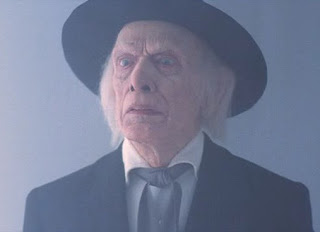
The Nanny (1965)

There's just something not quite right when Bette Davis stars as an English nanny. And is her 10 year-old charge an emotionally disturbed murderer or just an insolent brat? 

The Nanny is a 1965 British suspense film directed by Seth Holt and starring Bette Davis, Wendy Craig and Jill Bennett.  It is based on the novel of the same name by Evelyn Piper (a pseudonym for Merriam Modell), and the film was scored by Richard Rodney Bennett. The film was made by Hammer Film Productions at Elstree Studios.

Bette Davis is an English nanny whose charge is a rude 10-year-old Joey, just discharged from a disturbed children's home where he'd spent two years undergoing treatment for drowning his little sister in the bath. He returns to an unloving father, fragile mother, and doting nanny -- whom he hates. Suspicion arises again when his mother is poisoned, and Joey continues to insist Nanny is responsible. Joey contends the nanny was responsible for his little sister's death, and only the upstairs neighbour girl believes him.

Would you trust the nanny . . . or the boy?
This is obviously not Mary Poppins from the very start. It is a hugely atmospheric and very suspenseful pot-boiler and perhaps even one of Hammer's most underrated efforts ever.  "The Nanny" is non-stop suspense and tension right from the beginning until the twisty ending.

Nanny is so sticky sweet that you suspect something's wrong. On the other hand, she may just be that nice. Joey, who's coming home after being away for a couple of years, is revealed to be either an insufferable brat, or a terribly disturbed and frightened boy of 11 or so. Joey, who despises and harasses all middle-aged women, says Nanny is trying to kill him. Sweet Nanny is afraid someone may believe the child's irrational ravings. Mother Virgie, herself on the verge of total mental collapse, can't cope. Father Bill is too busy with business and travel, and too much the authoritarian parent to concern himself.

Calm Down Bitch
Bette Davis delivers a truly chilling performance in the role of the superficially friendly but sinister Nanny. 10-year old William Dix is also amazingly good in the lead. The film is creepily shot in black and white and the storyline bears several interesting twists. One of the film's greatest assets is the fact that it manages too keep up the suspense, and even the mystery about who is telling the truth. The twists are unpredictable, and it isn't clear until the film's climax whether the nanny is evil, or just the victim of a disturbed boy's morbid fantasy

The black and white picture definitely benefits the film, as it gives it that good old classic look and also provides more atmosphere than the film would have had if it was in colour. I suppose the only real criticism I can make of the film is that the plot sometimes drags, and there are long periods where not much happens. By the end, it's obvious that director Seth Holt was always building up to the conclusive twist; but it's well worked and the ending is likely to make most people that have watched it happy.

Another Memorable Davis Portrait!
Trivia:
According to writer Marcus Hearn in "The Hammer Vault", Davis unsuccessfully tried to seduce producer Jimmy Sangster. 

Ten year old co-star William Dix could not attend the film's British premiere because of the "X" rating it originally earned.

The role of the Nanny was originally intended for Greer Garson who first accepted then declined, saying the script would not be good for her career. Jimmy Sangster who wrote and produced the film later said, "I went to Santa Fe and met with Greer, and she said she liked the script, and everything was fine. When I got back to London, we had a message from L.A. saying that Greer Garson didn't think the script would do her career much good. I didn't like to say she didn't have a career in those days."

The last film of Nora Gordon. 

Director Seth Holt found Bette Davis "impossible" to work with.

Working with the flu, Bette Davis would drink out of her co-stars' glasses and cough in their faces. 

Bette Davis forced co-star Jill Bennett to walk behind her at the dog track one night because she thought she was underdressed.

Jill Bennett says Bette Davis gave her one important acting tip: "make love to the furniture." 

The battery-powered walking robot toy Joey is playing with is a Horikawa "Silver Gear" model, made of tin in Japan. In good working condition it could be worth $800, even without the box (in 2015).

Nanny wasn't responsible . . . WAS SHE?

A Bucket Of Blood (1959)

A frustrated and talentless artist finds acclaim for a plaster covered dead cat that is mistaken as a skillful statuette. Soon the desire for more praise leads to an increasingly deadly series of works. 

A Bucket of Blood is a 1959 American black comedy horror film directed by Roger Corman. It starred Dick Miller and was set in beatnik culture. The film, produced on a $50,000 budget, was shot in five days.  It was written by Charles B. Griffth.

Walter Paisley, nerdy busboy at a Bohemian café, is jealous of the talent (and popularity) of its various artistic regulars. But after accidentally killing his landlady's cat and covering the body in plaster to hide the evidence, he is acclaimed as a brilliant sculptor - but his new-found friends want to see more of his work. Lacking any artistic talent whatsoever, Walter has to resort to similar methods to produce new work, and soon people start mysteriously disappearing.

Roger Corman's Cult Classic is Bloody Good Fun!
A Bucket of Blood is one of those films that just seems to grow on you after each viewing (beginning with the first!). Dick Miller plays his most substantial role in his long and varied career as a very stupid, amoral busboy for a beatnik cafe. This sweet black comedy is one of the films that Roger Corman used to make before he got a bigger budget and went on to do fantastic adaptations of Edgar Allen Poe stores, starting with 'The Fall of the House of Usher', the year after this was made.

Aside from being a cheap black comedic exploitation thriller, A Bucket of Blood is also a commentary on the art world. Anything can pass for a masterpiece when it comes to being 'creative'.
The jazz styling makes a nice atmosphere for the movie and it helps to capture the pseudo-cool jazz trend that is often associated with art in the late 50's and early 60's.  "A Bucket of Blood" is a truly slick and ingenious little quickie that terrifically blends the classic terror premise of "Mystery of the Wax Museum" with the typical psychotronic-humor that Corman largely invented himself.

A Comedy of Errors! A Comedy of Terrors!
The character of Walter Praisley is a clumsy waiter and wannabe artist whose biggest wish to get as famous as the talkative stars he serves coffee to every day. His dream accelerates rapidly and unexpectedly when he covers his landlady's dead cat in clay and people proclaim it an art-masterpiece. Walter naturally enjoys his easily earned artist-status but he also realizes that he'll have to move on to bigger projects if he wants to stay in the picture.  You can only imagine what comes next after that cat. Daddy O what will he do?

Be on the look out for the fat bearded character Maxwell, this guy is a total riot.  Perfect portrayal of those fucking beatniks. Surrounding the film is a hip and jazzy score that manages to spice up proceedings by gelling together with its artistic context. Director Corman manages to keep things moving at a reasonable pace with it flying by quick enough. He succeeds in making a fun satire that has whole range of surprising developments and he knows when to tighten the screws with some razor edge thrills, which makes way for a satisfyingly, ingenious outcome. No way is life imitating art here.
That's right Daddy-O.  Read my poem at the end of this review.
Excellent screenplay by Charles Grifith, and fine playing by supporting cast, especially Julian Burton as the beatnik leader and Antony Carbone as the conflicted café owner. Lovely Barboura Morris is enchanting as always. The sets and locales have an oddly convincing feeling, as if we had stumbled onto a beat hangout and ended up observing the various poetry readings and art shows. Because of this, the movie captures a unique moment in time when such places and people actually existed.

Necrophiles may indeed dance upon the placemats in an orgy of togetherness.  Burn gas buggies and whip your sour cream of circumstance and hope.  A ton of fun for those with a macabre sense of humor or are genre fans of the wax-museum type horror flicks. Take me to some cool blue place...and gas me!  An excellent example of Corman's work.

The King is here
Trivia:
The line about how "artist" Walter Paisley "knows his anatomy" is apparently a nod to the similar themed House of Wax (1953) which used the same line about Vincent Price's character. Of course, a year later, Vincent Price became Roger Corman's favorite star.

The sets for this film would be re-used for Roger Corman's next production The Little Shop of Horrors (1960).

Julian Burton is reported to have actually written the entire 'Life is a bum' poem himself, taking care to make the poem imitate- and yet parody- 'beatnik' art at the same time.

When preview audiences saw Maxwell arrive in a tuxedo and sandals, it caused them to chuckle because it seemed so appropriate to the character...however, it was actually because Julian Burton had swollen feet due to wearing the sandals constantly and had no choice.

At the time of its original release there was a promotion in the newspaper's movie section advertisements that made the offer, "If You Bring In A Bucket Of Blood To Your Local Theater's Management (Or Ticket Booth), You Will Be Given One Free Admission."

Reportedly star Dick Miller was unhappy with the impact of the low budget on the film. Miller felt the film had terrific potential to be a classic and liked the script and performances, but felt the lack of funding weakened some of the films best moments. In particular Miller cited the conclusion of the film saying that it suffered due to little time or money for makeup effects.

Groovy
 Though Dick Miller is a recognizable veteran actor who's appeared in well over one hundred films, 'A Bucket of Blood' is one of only three films in which he had a starring role, the others being 'Rock All Night' and 'War of the Satellites.'

Anthony Carbone spends the entire film limping and walking with a cane. This being a Roger Corman film, one might logically assume Carbone injured himself and just soldiered on, but in fact he was perfectly healthy and adopted the limp because he felt it would make his character more interesting.

The entire film was shot in five days.

Roger Corman and Charles B. Griffith developed the idea and basic outline of the film in one day.

The working title of the film was 'The Living Dead'.

The films origin came about when American International Pictures approached Roger Corman to direct a horror film for them but only alloted a small budget and an extremely limited schedule. Corman took the challenge, but wasn't interested in directing a traditional horror film, so he and screenwriter Charles B. Griffith came up with the concept of creating a black comedy instead.

The guitar player (and singer) at the night club is Alex Hassilev, who was soon to form the popular folk trio The Limeliters with Louis Gottlieb and Glenn Yarbrough.

Inside every artist... Lurks a mad man!
Director Roger Corman and writer Charles B. Griffith went to coffeehouses on the Sunset Strip to do 'research' for the beatnik characters they would create for this film.

The films original poster art was a series of comic strips that hinted at the macabre story of the film.

In 2009 a musical production of 'Bucket of Blood' was produced by Chicago's Annoyance Theatre.

Maxwell's line, "And no one knows that Duncan is murdered and no one knows that Walter Paisley is born ...", is a reference to the death of King Duncan in "Macbeth" by William Shakespeare.

Will YOU join his human museum?
 Maxwell H. Brock: I will talk to you of Art, for there is nothing else to talk about, for there is nothing else... Life is an obscure hobo bumming a ride on the omnibus of Art. Burn gas, buggies, and whip your sour cream of circumstance and hope, and go ahead and sleep your bloody heads off. Creation is, all else is not. Creation is graham crackers; let it all crumble to feed the creator; feed him that he may be satisifed. The Artist is, all others are not. A canvas is a canvas or a painting. A rock is a rock or a statue. A sound is a sound or is music. A preacher is a preacher, or an Artist. Where are john, joe, jake, jim, jerk? dead, dead, dead They were not born before they were born, they were not born... Where are Leonardo, Rembrandt, Ludwig? Alive! Alive! Alive! They were born! Bring on the multitudes with a multitude of fishes: feed them with the fishes for liver oil to nourish the Artist, stretch their skin upon an easel to give him canvas, crush their bones into a paste that he might mold them. Let them die, and by their miserable deaths become the clay within his hands that he might form an ashtray or an ark. Pray that you may be his diadem: gold, glory, paint, clay, that he might take you in his magic hands and wring from your marrow wonder. For all that is comes through the eye of the Artist. The rest are blind fish swimming in the cave of aloneness. Swim on you maudlin, muddling, maddened fools, and dream that one bright, sunny night the Artist will bait a hook and let you bite upon it. Bite hard and die!... in his stomach you are very close to immortality.  

I'd rather see you pull out a testicle than an acoustic guitar at a party.

Poltergeist 3 (1988)

Carol Anne has been sent to live with her Aunt and Uncle in an effort to hide her from the clutches of the ghostly Reverend Kane, but he tracks her down and terrorises her in her relatives' appartment in a tall glass building. Will he finally achieve his target and capture Carol Anne again, or will Tangina be able, yet again, to thwart him?  

Poltergeist III  is a 1988 American horror film and is the third and final entry in the original Poltergeist film series. Writers Michael Grais and Mark Victor, who wrote the screenplay for the first two films, did not return for this second sequel; it was co-written, executive produced, and directed by Gary Sherman, and was released on June 10, 1988 by Metro-Goldwyn-Mayer Pictures.  

They're back... again.
Staying in Chicago with relatives Bruce, (Tom Skerritt) and Patricia Gardner, (Nancy Allen) and their daughter Donna, (Lara Flynn Boyle) Carol Anne Freeling, (Heather O'Rourke) is trying to start life over with a new family. Almost as soon as they get settled in with each other, strange phenomena begin affecting the family at different locations. They are misinterpreted by her school teachers as something wrong with her, and think she needs to be treated accordingly. Carol Anne was telling the truth, as Reverend Henry Kane, (Nathan Davis) tracks her down and uses his spirits to help him.

Shitty little sequel filled with annoying characters and some horrible dialog.  Only Heather O'rourke and Zelda Rubinstein are hold overs from the original cast. If O'rourke and Rubinstein were smart they would have skipped participating in this bomb of a movie also.  This movie suffers from a bad script and bad acting highlighted by the actor who plays Dr. Seaton, who may have given the worst acting performance ever.  I could get the guy up the street with the "I Will Work For Food Sign" to do a better job.  There is a certain sadness in watching this film knowing that Heather O'rourke died a few months before it's release. A double for Heather is used to shoot the final scenes of the movie which creates an odd and choppy ending.  To her credit though she is the least annoying character in the movie as she is one of the few who doesn't yell out "CAROL ANNE" one hundred times.

Please pull me out of this horrible film.
 The effects.....bad.  There just are not the cool special effects from the previous two installments. Instead of ghosts we get killer cars and people who are different in mirrors that kill people by pushing them down.  The ending was disappointing; I would have preferred the original ending. It's a real disappointment that it's impossible to see the deleted scenes, including the original ending.  Do not watch without consuming lots of alcohol. MGM put this out on DVD with part II, probably because they thought (correctly) that no one would buy part III on its own.

Trapped in the limbo between life and death, there are only two ways out.
Trivia:
In this film alone, Carol Anne's name is spoken a total of 121 times. 

Following the death of Heather O'Rourke in February of 1988 after she finished her work on the film (April-June 1987), it was the decision of director Gary Sherman to temporarily shelve the project during its post-production phase. However, due to the amount of money that had already been spent, MGM insisted that the film be finished and released as scheduled for June of 1988 or they would find someone else to do it. Apparently, after the film was given a PG rating by the MPAA in November 1987, the studio had already decided to have Sherman re-shoot the ending with more graphic scenes, in order to "up" the rating to PG-13. Planning for this re-shoot began in December 1987 and continued into January 1988, but was temporarily put on hold when O'Rourke died Feb. 1. The re-shoot (which used a stand-in for Heather) eventually took place in March, and the film was then "re-edited" and given a PG-13 by the MPAA in April 1988. Director Sherman would later claim that no such "re-shoot" took place, instead insisting that Heather died before they could film the "original ending" and that the current ending using the body double was what they hastily threw together when forced to "finish" the film by MGM. However, he is contradicted by at least six other people who also worked on the film who confirmed that the original ending was in fact filmed before Heather died and that the re-shoot of the ending took place after her passing. These people include producer Barry Bernardi, actor Kipley Wentz, assistant editor Jeanne Bonansinga, composer Joe Renzetti, special effects makeup artist Doug Drexler and the man who provided the voice for the Rev. Kane, Corey Burton.  

Lara Flynn Boyle's film debut. 

At the beginning of the film, the characters mistakenly believe that the weather outside is cold. When they descend from the upper floors to the ground level however, they find that it is in fact quite warm. This phenomenon of weather varying from the upper to lower floors actually does occur at the Hancock Center due to the building's height. Residents often call the lobby doormen before leaving their apartments to find out what conditions are like at ground level.

He's found her.
Zelda Rubinstein had to leave the production midway because of her mother's death.  

Tom Skerritt makes a reference to Brian De Palma's Carrie (1976) to Nancy Allen. This is presumably an in-joke, as Allen had starred in that film, as Chris Hargenson, back in 1976. 

End credits explain that the role of Reverend Kane had originally been portrayed by Julian Beck.  

After filming of the scene where the cars chase Patricia and Bruce, the car's explosion set the entire set on fire, almost taking a crew member and a few cameras he was rescuing. When Heather O'Rourke showed up for filming the next day and heard about the incident from director Gary Sherman, she was relieved that no one was hurt. She then asked Sherman, "Did you get the shot?" 

Although much of the film is set in Chicago's John Hancock Center, the shopping area and parking garage as seen in the film do not exist in the Hancock Center. The shopping area (especially the escalators seen immediately before the art gallery sequence) is across the street, in the Water Tower Place shopping mall. The parking garage is definitely not the Hancock Center's, it was filmed in a high rise dual tower complex called "Oakbrook Terrace" in a suburb west of Chicago.  

Although there was an internet rumor that Jerry Goldsmith was originally contracted to score this film but quit due to budget cuts (and then supposedly used his "unused" P3 score later in The Haunting (1999)), this rumor is untrue. Goldsmith was unhappy with the results of Poltergeist II: The Other Side (1986) and did not have an interest in doing the third film. Also, it's clear that MGM did not want to spend the extra money they knew it would cost to hire Goldsmith, considering that "Poltergeist III" was being made on a lower budget than the last film. Ultimately, "Poltergeist III" was scored by Joe Renzetti, who director Gary Sherman recommended, having worked with Renzetti previously on his other low-budget movies. 

Guess who's back in town.
This is the only film in the original trilogy that did not receive any Oscar nominations.  No shocker there.

Producer David E. Kelley has quite a connection to this film. He cast Tom Skerritt and Zelda Rubinstein in his Emmy-winning TV drama Picket Fences (1992) after seeing them together in this film. The character of Skerrit's daughter was played by Holly Marie Combs on the show. That character is reminiscent in character and physicality to Lara Flynn Boyle's character Donna Gardner in this film. Nancy Allen was originally cast to portray the town's mayor in Season 2 of "Picket Fences" but had to drop out due to her contractual obligations to appear in RoboCop 2 (1990) and RoboCop 3 (1993). That role was then filled by Leigh Taylor-Young. 

The Light that Dr Lesh talked about in Poltergeist (1982) that appeared at the climax of Poltergeist II: The Other Side (1986) and Tangina mentions at the end of this film may derive from war stories that pilots claim to have seen in combat.  

The producers were granted permission to use the John Hancock Tower in Chicago for shooting providing that none of the building's residents would be disturbed. The sixty person crew took four weeks just o figure out the logistics, and ultimately the tenants even noticed that the film was hooting there. 

In the original ending that was scraped after Heather O'Rourke's tragic death, when Patricia jumps through the glass pane into the apartment, she finds Carol Anne, Donna, Scott, Bruce and Tangina frozen and dying. She then also becomes imprisoned in ice and gets attacked by Kane and her evil mirror reflection who want the necklace. Patricia tries to repel them and declares unconditional love for her family, but trips over frozen Tangina and falls to the floor. Suddenly, Tangina frees her arm from the ice and grabs the necklace. She convinces Kane that she is the one who can take him to the other side, not Carol Anne. Kane puts his hand on the necklace, but instead of ascending, his face cracks and he explodes. The blast frees everyone, but annihilates Tangina and causes a violent thunderstorm. Patricia, Carol Anne, Donna, Scott and Bruce finally leave the mirror dimension. Carol Anne sees a reflection of smiling Tangina in the mirror who waves at them and sheds a tear. With the shot of a rising morning sun, the movie ends.

The cast and crew we can blame for making this movie.
 

Bloody Birthday (1981)

Lacking consciences because they were born during a solar eclipse, a trio of 10-year-olds embark on an indiscriminate killing spree.

Bloody Birthday is a 1981 slasher film directed by Ed Hunt and produced by Gerald T. Olson. 

In 1970, three children are born at the height of a total eclipse. Due to the sun and moon blocking Saturn, which controls emotions, they have become heartless killers ten years later, and are able to escape detection because of their youthful and innocent facades. A boy and his teenage sister become endangered when they stumble onto the bloody truth. 

This is an interesting and fun little horror movie from the early 80's that probably had a brief run in the drive-ins.   Not a masterpiece for sure, but still entertaining and surprisingly enough, it doesn't really have a lot of unintentionally funny scenes.  

The Nightmare Begins With The Kids Next Door
The title alone is quite misleading though since the body count and gore (blood) pale in comparison to other slasher films.  But these kids are ruthless jack. These little mother fuckers are shooting, stabbing and strangling their victims, stalking people with guns, spying on people having sex, pretending to put poison in a birthday cake, keeping a scrapbook with obituary clippings and doing all types of fucked up things.  And on a side note Downtown Julie Brown has a nude scene.

The kid probably wandered on the wrong set and he was really supposed to go to Revenge of the Nerds.   
Unfortunately no real explanation is provided for the kids sudden homicidal mania.  "Bloody Birthday," like many other films of 1981, is a film to be watched with tongue in cheek, and a six pack (or more) of beer.  The movie has some truly inventive killings--if you just ignore the fact that no 10 year old could carry these out!  There's also room left for a sequel but since it's 2016 I doubt that's in the cards now. 
God Damn Indians
Trivia:
Lori Lethin did all of her own stunts.

Despite popular belief that the film was shelved for five years after being shot it has been confirmed that it was shot in early 1980 and released the following year. 

The astrology book Joyce consults is "Linda Goodman's Sun Signs." None of the material she supposedly reads out loud is from the book, however.

The house depicted in the films colorful German poster is the same house from the mini-series Salem's Lot (1979).

The debut film for producer Gerald T. Olson.

The films French title is Les Tueurs de l'éclipse, meaning "The Killers of the Eclipse" and its German release title was Kinder des Teufels, meaning "Children of the Devil." 

Body count: 8.
Quotes:
Curtis Taylor: [about to spy on Beverly] But what if she catches us?
Debbie Brody: No way. All her brains are in her bra!

Debbie Brody: [after they beat her father to death] Mommy mommy come quick! Daddy fell!

God Damn Cowboys

Sunday, October 25, 2015

Children Of The Damned (1964)

Scientists discovers that there are six children who each have an enormous intelligence. The children are flown to London to be studied, but they each escape their embassy and gather in a church. 

Children of the Damned is a 1964 science fiction film, a thematic sequel to the 1960 version of Village of the Damned. It is about a group of children, with similar psi-powers to those in the preceding film, but enabling an opposite interpretation of the children as a more good and more pure form of human instead of evil and alien.

Children of the Damned has generally been considered grossly inferior to Village of the Damned.  I don't know if I agree with that.  In Village of the Damned the children were the result of alien insemination (presumably) and were simply evil. In Children of the Damned they are the result of a jump in evolution and they, themselves, are unsure of who they are and why they are here.

The Plot.  A study, led by the United Nations results in bizarre and alarming findings. Six children, from all corners of the world, score unusually high on intelligence tests. It becomes even more remarkably when it seems that none of them has a father and all of them have label mothers. One mom even declared her boy is `not from this world'. While psychologists and other prominent scientists from all over the world search for explanations, the group of prodigies together seek shelter in an abandoned church….Things are getting more and more frightening when it turns out they're telepathic and able to hypnotize humans with their minds and eyes…

Bring me pork fried rice and a kabob.
 Rather than the aliens invaders of the first film, the children here are a human super-species, socially and intellectually incompatible with the rest of humanity. They don't seem to mean any harm, but their eerily cold and quiet presence provokes the authorities into a fearful contemplation of what they might do. John Briley's adult and intelligent script takes an insightful look at how our inherently insecure systems of authority might hunt and destroy that which merely suggests a challenge to their control.

The cast is excellent. Ian Hendry and Alan Badel as the two conscientious scientists trying to fathom the children's secret, are terrific. They bounce Briley's sometimes caustically witty lines between them with a delightful, naturalistic touch. The rest of the cast play it for keeps too, imparting a sense of urgency and, as with Alfred Burke's government man, icy menace.  The children themselves are surprisingly well played. No brattish over-acting here. Instead, the group of young, multi-racial actors exude a perfect sense of other-worldly calm, and, when necessary, chilling ruthlessness.

Paul we need to talk about how goofy your choice of attire is.
 The lead kid is named Paul and as a super genius, the dude doesn't dress himself very well.  Pull your socks down son. I hope mankind doesn't evolve to dress like that.  There is also a mix of kids.  We have the Indian kid, black kid and Chinese kid. They're not all blond haired and creepy eyes this time.

The production values of the film are excellent. In particular the stark black and white cinematography of Davis Boulton gives the film a strong sense of atmosphere and menace throughout which helps the film immensely. The production design of Elliot Scott give the film the same feeling as the cinematography, especially in the form of the destitute church the children come to occupy for much of the film. One element that improves in this film is the score by composer Ron Goodwin that, after a rather mixed result in the original film, is never out of place and put to good use throughout. The success of the production values helps the film out immensely.

Paul....lose the tie son.  You're 5.
Opinion about which of the 'of the Damned' films is better is seriously divided, but given the choice, I would always go for the freaky, blonde-haired and undeniably malevolent mutants of 'Village' over the normal looking, multi-cultural, and possibly benevolent saviours of mankind from 'Children'.  Viewing it is not a bad way to spend an evening.


Sunday, October 18, 2015

Village Of The Damned (1960)

In the English village of Midwich, the blond-haired, glowing-eyed children of uncertain paternity prove to have frightening powers.

Village of the Damned is a 1960 British science fiction film by German director Wolf Rilla. The film is adapted from the novel The Midwich Cuckoos (1957) by John Wyndham. The lead role of Professor Gordon Zellaby was played by George Sanders.

In the small English village of Midwich everybody and everything falls into a deep, mysterious sleep for several hours in the middle of the day. Some months later every woman capable of child-bearing is pregnant and the children that are born out of these pregnancies seem to grow very fast and they all have the same blond hair and strange, penetrating eyes that make people do things they don't want to do. 

This is an absolute masterpiece of paranoia, sci-fi style. The acting is superb, especially by the late and under-appreciated Mr. Sanders, whose compassion and intellect sets the tone for this quiet and somewhat sad little tale. The lovely Barbara Shelley as Sanders loving wife is sweet and totally believable. Indeed, the townsfolk are all very realistic and approachable, kind and simple folk who don't really deserve the wrath of the spooky children who have invaded their small town. Young Martin Stephens, who also turned in a creepy performance in the ghostly masterpiece "The Innocents" is every bit as creepy here as George and Barbara's "son."
 
Beware the stare that will paralyze the will of the world.
Special praise must also go to the director and photographer, Wolf Rilla and Geoffrey Faithful, who give the movie the detached air of a documentary. The script, credited to Stirling Silliphant, George Barclay and Rilla, is an excellent adaptation of a fine book, "The Midwich Cuckoos" by John Beynon Harris. Fans of this movie will want to read it. The book has many enjoyable details that were necessarily and wisely cut from the adaptation. To note one difference, the children in the movie are psychically linked: what one knows they all know. But in the book, the boys are psychically linked with the boys, the girls with the girls; but there is little or no link between the two sexes. The reasons for this are fascinating.

The funniest part of the film was the dude that looked just like the country singer Lyle Lovett. I kept waiting for him to break out in song. 

Lyle Lovett looks over the situation.
Lyle Lovett surrounded by those creepy kids.
"Village of the Damned" is a mysterious and scary horror movie, with an original story in the style of "The Twilight Zone". The plot is intriguing and has not aged. The performances are excellent and the simple special effect of the eyes of the children associated to their performances is frightening.  Village of the Damned is a good way to spend an hour and a quarter one evening. Very creepy.

What Demonic Force Lurks Behind Those Eyes?
 Trivia:
The eerie effect of the children's glowing eyes was created by matting a negative (reversed) image of their eyes over the pupils when they used their powers.

Originally begun in 1957 as an American picture to star Ronald Colman, MGM shelved the project, because it was deemed potentially inflammatory and controversial, specifically due to its sinister depiction of virgin birth.  

The blond wigs that the children wear had a built-in dome to give the impression that they had a larger than normal cranium. 

The source novel is called The Midwich Cuckoos. This is because when cuckoo birds lay eggs, they deposit these eggs in the nests of other birds, who then raise the cuckoo chicks as their own. Compounding the insidious nature of this process, the cuckoo chicks often murder their nestmates in competition for food and parental attention.  

Ronald Colman was originally supposed to star in this film. He passed away in 1958 and was replaced by George Sanders, who had married Colman's widow Benita Hume in 1959 

The map co-ordinates for Midwich, given over the radio when pilots are being advised to avoid the local airspace, refer to the real life village of Woodmancott in Hampshire.  


Blue Hawaii (1961)

Chad Gates has just gotten out of the Army, and is happy to be back in Hawaii with his surf-board, his beach buddies, and his girlfriend. His father wants him to go to work at the Great Southern Hawaiian Fruit Company, but Chad is reluctant. So Chad goes to work as a tour guide at his girlfriend's agency 

Blue Hawaii is a 1961 American musical romantic comedy film set in the state of Hawaii and starring Elvis Presley. The screenplay by Hal Kanter was nominated by the Writers Guild of America in 1962 in the category of Best Written American Musical.

Let me just say that you cannot fuck with young Elvis.  Not the old, fat, drugged out Elvis.  Young Elvis was cooler than the other side of the pillow.  The ultimate Elvis Presley musical of the 1960's-and the biggest box office success of his entire Hollywood career. 'Blue Hawaii' is the one that certainly hit the highs with it's blend of comedy, romance, music, scenery and a bevvy of beauties! 

Elvis Presley rides the crest of the wave
An Elvis movie wouldn't be an Elvis movie if he didn't chant his way through a number of songs and with 'Blue Hawaii' this culminated in a total of fourteen.  Elvis will pull out a fucking guitar and belt out a song anywhere.  This film, with its big budget and great soundtrack, laid the groundwork for the Elvis movies made later. Unfortunately, as Parker had negotiated a percentage of each film, it didn't take him long to realize that the faster and cheaper they made them, the more money for him and, by extension, Elvis.  The soundtrack is quite possibly the best of any Elvis movie, with such gems as "Can't Help Falling In Love," the toe-tapping "Rockahula," "Hawaiian Wedding Song" and an abbreviated but still enjoyable rendition from Elvis of the traditional Hawaiian classic, "Aloha Oe."

Elvis was in top form here - handsome, slim, and boyish. A far cry from the overweight, ostentatious, muttonchopped, rhinestoned, caped and bell-bottomed joke he became a decade later. The rest of the cast was good, with the exception of an over-the-top Angela Lansbury and a cold, unmusical Joan Blackman.

Ecstatic romance...exotic dances...exciting music in the world's lushest paradise of song!
The story is a sparse affair concerning Chad, a returned G.I. who wants to make his own way in life but whose overbearing mother (Angela Lansbury, great as usual) wants only to hear of him working in the family's pineapple business. Chad figures out a way to get a job with a tourist agency taking advantage of his knowledge of the islands, but a crisis involving one of his underage charges threatens to cut his new career short.   "Blue Hawaii" was clearly intended as wholesome family entertainment, but there are two points at which it might cause some raising of eyebrows today. The first is the (presumably) unintentional double entendre which occurs when Maile asks Chad whether he can satisfy a teacher and four teenagers. The second comes when Chad picks Ellie up, puts her across his knee and gives her a good spanking.  You read that correctly.  A 17 year girl is hell bent on singing into Elvis's mic.
Say my name bitch.....
Blue Hawaii marks the height of Presley's singing and film career. The Beatles hadn't come on the scene yet, the King was still ruling the roost on the record charts and his films were grossing big box office.  Definitely a must see for Elvis fans and a watchable one for non-Elvis fans.

Elvis is, as usual, surrounded by pussy.
Trivia:
Turn the sound up loud when Chad (Elvis Presley) is first seen leaving the plane and you will hear hundreds of screaming fans who were watching the shoot.

Angela Lansbury, who played Elvis Presley's mother, was only 35 years old when the movie was filmed, a mere ten years older than Elvis. 

The closing scene, where Elvis Presley is getting married by the pool, was shot at the Coco Palms Resort on Kauai, where Elvis was staying when filming the movie.

Approximately seven minutes before "The End," Maile (Joan Blackman) kicks Chad (Elvis Presley) out of her room on Kauai, then peeks through the blinds. Briefly in her view is a couple paddling a canoe. The woman, blond and seated in front, is pop singer Patti Page. How Patti paddled her way into being an extra came about because she was then married to Charles O'Curran, a choreographer and music stager for many films produced by Hal B. Wallis, including this one. 

The red MG roadster which opens the film was often seen in the first half. Presley liked the 1960 MGA 1600 MkI so much that he bought it. It now resides in Graceland at his car museum with his motorcycles, Cadillacs, Stutzs and other vehicles.

 Juliet Prowse, Elvis Presley's co-star in G.I. Blues (1960), was signed to play Maile, but she wanted to use another studio's make-up artist and have the studio pay to fly her secretary to Hawaii. When those conditions were refused, she pulled out of the film.

Elvis Presley gave his famous ukulele from this film to Hank Garland, nicknamed "Sugarfoot." Garland was one of the top session guitar player during the 1950s in Nashville. He recorded with Elvis and toured with him from 1958-1961. Elvis etched his initials into the ukulele for Garland. During his 1961 Hawaiian benefit concert (for the Arizona Memorial), Elvis was quoted as saying that Garland was "one of the finest guitar players in all of the country." 

The soundtrack album for this movie is not only Elvis Presley's most successful chart album, but it is also the #1 album overall for 1961. "Blue Hawaii" spent 20 consecutive weeks at the #1 spot on Billboard Top LPs chart in 1961-1962 (a record to be broken only in 1977 by Fleetwood Mac's "Rumors" album), and it stayed on the charts for 79 weeks.

Unsure why Elvis is singing to a group of dudes. 
 Jenny Maxwell, who plays Ellie Corbett, was later the victim of a famous never solved murder when in June of 1981 she and her husband, prominent attorney Ervin "Tip" Roeder were gunned down at the entrance to their Beverly Hills condo. Police were never able to develop a viable suspect or motive for the double homicide. It was eventually written off as a botched robbery but it is worth noting that at the time of the murder Roeder was aggressively campaigning to reopen the investigation into the death under mysterious circumstances of another prominent actor, Nick Adams. Adams death was ruled an accidental drug overdose but many of his friends, including Roeder, didn't accept this explanation believing that Adams had probably been murdered.

Joan Blackman was in two movies with Elvis Presley 

Film debut of Pamela Austin.

You can't stop love

Topper (1937)

A fun-loving couple, finding that they died and are now ghosts, decide to shake up the stuffy lifestyle of a friend of theirs.

Topper is an American comedy film starring Constance Bennett and Cary Grant which tells the story of a stuffy, stuck-in-his-ways man, Cosmo Topper (Roland Young) who is haunted by the ghosts of a fun-loving married couple.

A fun-loving couple, wealthy Long Island socialites George and Marion Kerby (Cary Grant & Constance Bennett), return from the dead after a fatal car accident in their flashy roadster to help a henpecked husband Cosmo Topper (Roland Young). Cosmo is the Wall Street bank president where George is on the board of directors, as the largest stockholder. The change of life for the middle-aged Cosmo comes when over his overbearing wife Clara's (Billie Burke) objection, he buys George's reconditioned convertible speedster. He's soon haunted by the ghosts of George and Marion, who want to do Topper a good deed so they can leave the Earth and be free from their state of limbo. Their good deed involves loosening up the staid banker. The friendly ghosts are sometimes visible and sometimes can't be seen but can be heard. Their carefree ways supposedly make Cosmo a better man and brings him closer to his wife, but also brings chaos to his once orderly life.

The wound him up and let him run...Riot!
With a fine cast and some good and occasionally impressive special effect camera tricks, this is a decent fantasy feature. It makes its main gimmick work well, while also telling a light but interesting story about the main characters. The idea of ghosts returning to interact with the living is a simple and familiar idea, but in this movie it works pretty well.  

The 'ghost' effects are very good technically for their time, and they are used effectively in the story. There is a lot of variety in the various visual effects, and they show some clever ideas and careful planning. Only a couple of times do the seams show.

Roland Young is the perfect Topper - henpecked, confused, and a nervous wreck. He's a man dying to break free of his shackles, and he's always envied George and Marion's lifestyle, even though it killed them. His frustration and unhappiness make him sympathetic, and the audience is with him all the way.
You shouldn't drink & drive. 
Topper is one of those films that probably could do with a remake.  If you've never seen this movie, treat yourself.  From one spooky set up to the next, Topper is a cure for the blues, be it fisticuffs with cops, or turning a hotel inside out, it is quite simply a delicious piece of 30s comedy pie.  

Constance Bennett Showing a man a good time was her daily "Good Deed"
Trivia:
The fancy finned-back car driven by the Kerbys was custom built by the Bohman & Schwartz Co. using a 1936 Buick Roadmaster chassis. Originally the producers had in mind to use a coffin-nosed Cord, but it wasn't large enough. In the custom-made Buick there were special compartments for camera equipment, etc. The Buick resembles a Cord, but the supercharger pipes on the side were just decorations (a Cord comes with an actual supercharger). After filming the Buick was bought by the Gilmore Oil Co. and was used for promotional purposes for many years. It was updated in 1954 with a Chrysler Imperial chassis and drive train. The car driven by Cosmo Topper is a 1936 Lincoln Model K.  

Arthur Lake, the elevator boy/bellhop, went on to star as Dagwood Bumstead in the "Blondie" movies and TV series. 

The commercial and critical success of this film led director Norman Z. McLeod to include much of the principal cast in his next film, Merrily We Live (1938). Constance Bennett, Alan Mowbray, and Billie Burke all received major parts in McLeod's next work, with Mowbray reprising his role as a stuffy butler and with Burke again playing the matriarchal head of a household.  

This was the first black & white film to be "colorized" in 1985. 

Second film appearance of Lana Turner; she was uncredited and had no lines.

Oh, George, I can see right through you.
Producer Hal Roach wanted W.C. Fields and Jean Harlow to star as, respectively, Cosmo Topper and Marion Kerby, but neither was available at the time.

This is the first of three films that Hal Roach adapted from a Thorne Smith novel. 

The easiest part of the shoot for Cary Grant and Constance Bennett was the many special effects scenes, which only required them to record their lines while special effects artists made the various items they moved, from fountain pens to a pair of frilly lace panties, appear to move on their own.

In addition to the stress of her career problems, Constance Bennett was dealing with her sister Barbara's alcoholism, which left her short-tempered on the set. She also was frequently late. 

The entrance to the Seabreeze Hotel, where Topper and the ghosts check in for a little fun, was filmed in front of Bullocks Department store on Wilshire Boulevard in Los Angeles.

A production still for the film included Natalie Moorhead in the film, but she was not in the viewed print and her role may have been cut from the released film. 

Hal Roach immediately wanted Cary Grant to play George Kerby, but he had difficulty getting the actor to agree to play the part, since Grant was concerned about the supernatural aspects of the story. Assurance from Roach that the screwball aspects of the story would be played up - plus a fee of $50,000 - were sufficient to convince Grant to do the film.

Songwriter and pianist Hoagy Carmichael makes an uncredited cameo appearance, early in the film, as the piano player in the sequence where George and Marion are on the town the night before the meeting at the bank. He introduces the song "Old Man Moon", which is sung by George and Marion (It's also sung later by Three Hits and a Miss). It was Carmichael's screen debut. As the couple leave the bar, George says "(Good) night and Carmichael replies "So long, see ya next time." 

The music in the scene where the bell boy trips over the curb as topper leaves the hotel and again as topper "rises" from the dead, the background music heard is the eight note theme later used in the Harry Potter series.