Translate

Saturday, January 23, 2021

Torture Garden (1967)


An anthology of four short horror stories about people who visit Dr. Diabolo's fairground haunted-house attraction show.

Torture Garden is a 1967 British horror film directed by Freddie Francis and starring Burgess Meredith, Jack Palance, Michael Ripper, Beverly Adams, Peter Cushing, Maurice Denham, Ursula Howells, Michael Bryant and Barbara Ewing. The score was a collaboration between Hammer horror regulars James Bernard and Don Banks.

A special sideshow torture exhibit has the power, according to showman Dr. Diabolo (Burgess Meredith), to warn people of evil in their futures. One by one, skeptical customers stand before the Fate Atropos to be shown the greed and violence they're hiding behind their respectable façades.

Where Nothing Grows But Fear!

Torture Garden is a very misleading title for this movie because there is no torture and no fucking garden. It's written by Robert Bloch and directed by Freddie Francis. There are four stories plus the linking/wraparound story.  Every story was written by Bloch who was also the author of Psycho. There's nothing here as good as Psycho but a few of the stories aren't bad at all. 

Story 1 is about a dead witch who possesses a cat and causes an inheritor to rue his greediness. It's entertaining. That's what the dude gets for fucking around and opening up a coffin. If you happen to find a coffin in the basement don't open the damn thing.  Also if a live car jumps out of the coffin leave the fucking house. 

Story 2 is more mysterious than horrific but the story about androids is, at least, relatively original.  Beverly Adams is the star and she's incredibly beautiful.  She also starred in "How To Stuff A Wild Bikini" and believe me she can stuff that bikini. 

I Bet You Can Stuff A Wild Bikini

Story 3 is a distinctly silly episode about a piano "with a mind of it's own", who kills it's player's lover. It's not just silly but fucking stupid.  The girl should have been dating a guitarist anyway.  Eveybody knows the guitarist and lead singer get all the chicks. 

Story 4, is about the resurrection of Edgar Allan Poe.  This is easily the best story here and Jack Palance and Peter Cushing are awesome.  I love Peter Cushing in just about every film he's been in. 


This has been called the worst of the Amicus anthologies. That may be true, but it is still enjoyable. "Torture Garden" is entertaining enough for fans of Horror omnibuses, but I'd recommend most other Amicus anthologies (especially the excellent "House That Dripped Blood") over this one. Positive points are a nice atmosphere and look, but overall "Torture Garden" is just OK.

Do You Dare See What Dr. Diabolo Sees?

Trivia:

When this movie was shown in 1967, one of the promos was a pack of torture garden seeds given to patrons as they entered the theater. The seeds were actually grass seeds.

Despite being present from the opening, and also top billed, Jack Palance (Ronald Wyatt) does not speak until one hour and fifteen minutes into this movie.

"Columbia Pictures" financed this movie and insisted that two American actors be cast. Therefore, the initial casting of Peter Cushing (Lancelot Canning) and Sir Christopher Lee was changed to that of Jack Palance (Ronald Wyatt) and Burgess Meredith (Dr. Diabolo).

A scene featuring Burgess Meredith is used at the beginning of the film "See No Evil" (1971) on a TV set in a shop window.


This movie was released in the U.S. as the top half of a double feature with "Trog (1970)," which was Joan Crawford's final movie. Both movies were directed by Freddie Francis.

Barbara Ewing (Dorothy Endicott) received an "introducing" credit.

Robert Hutton (Bruce Benton) and Peter Cushing (Lancelot Canning) died only four days apart: Hutton on August 7, 1994 and Cushing on August 11, 1994.

After The Twilight Zone: Printer's Devil (1963), this was the second time that Burgess Meredith played the Devil.


Thursday, March 19, 2020

The Funhouse (1981)


Four teenage friends spend the night in a carnival funhouse and are stalked by a deformed man in a Frankenstein mask.

The Funhouse (also released as Carnival of Terror) is a 1981 American horror film directed by Tobe Hooper, written by Larry Block and starring Elizabeth Berridge, Kevin Conway, William Finley, Cooper Huckabee, Miles Chapin, and Sylvia Miles. The film's plot concerns four teenagers who become trapped in a dark ride at a local carnival and are stalked by a deformed killer inside.

Up until The Funhouse, Tobe Hooper had only come pretty close to recapturing the relentless and ruthlessly nightmarish feel of the classic that catapulted him to fame, The Texas Chainsaw Massacre. Funhouse goes back to Hooper's roots, trading in the gore for playing with your nerves like Jimmy Page playing guitar. Traveling carnivals have always had a sinister, menacing undertone to them - that's part of what makes them so attractive - and Hooper, with a smart assist from Larry Block's script, takes that queasy unease and turns it up to '11', so that when the true horror is revealed, it's intensified that much more.

Pay to get in. PRAY to get out.
Four friends on a double date and decide to hole up in the Funhouse of a traveling carnival just outside of town way past closing time, just for kicks. It's a weird place that gives off a freaky vibe, but they don't come to realize just how freaky, until they see something that puts all of their lives in danger, and realize to their horror that not all the freaks in the show are fake...or at all "fun".

An endless amount has been written about Tobe Hopper's fall from grace. Much like a soccer player that scored thirty goals in his first season and just one in the next, the downhill slope for the quality of his work was stark and unrelenting. The Spielberg collaboration on Poltergeist was supposed to launch Hooper as a Hollywood suspense maestro that would rival Hitchcock and Kubrick. Unfortunately the movie started a slope to mediocrity from which his career has never recovered. Generally movie fans look back on The Texas Chainsaw Massacre as the only truly outstanding feature in his catalogue. This record is somewhat inaccurate, because despite the inferiority of the majority of his later work, Funhouse is a decent feature that deserves further recognition.


Why Tobe Hooper never became the horror maestro that so many predicted is a mystery. Funhouse proves however that there is more to his catalogue than a Chainsaw Massacre in Texas. By far one of the best of the early eighties slashers, this entry deserves to be highly regarded.

It's an entertaining film. The funhouse robots are pretty rad, and the monster is badass. The kills could have been a little more gory...but the one where they accidentally axe their friend is great! There's a nice amount of tension in that final scene too.

The freak is played by Wayne Doba who is passionate in his portrayal and extremely credible. Plus the make-up is hideous and memorable. I also liked the depiction of the monster's relationship with his dad, the Funhouse Barker played by Kevin Conway. All-around outstanding job on this front.

If he wasn't bullied in school, he should have been.
Hooper also spends far too much time on following Joey as he mooches around the carnival. Since Joey has no particular involvement in the plight of the teens, his inclusion is redundant and best left on the cutting room floor.  Joey is the stupid kid brother and I was hoping the freak would kill his annoying ass. If he wasn't bullied in school he should have been.

Overall, you have to give Tobe Hooper credit for this one. It's stylish, imaginative, and held my attention the whole way through. "The Funhouse" is different, but it's one of the more memorable horror films to come from the '80s decade. It may not be an all-time classic like Hooper's "Texas Chainsaw Massacre" or "Poltergeist", but it's surely one of his better films overall. Definitely recommended if you are a fan of Hooper, or enjoy a good old slasher flick.

Something is alive in the funhouse...something that has the form of a human, but not the face...something that feeds off the flesh and blood of young innocents...
Trivia:
Dean R. Koontz wrote a novelization of the screenplay under the pseudonym Owen West. The book contains a lot of backstory added by Koontz. Because of this, and the fact that the book was released before the movie due to a delay in post production, it is often mistaken that the movie is based on the book, but the book is in fact based on the movie.

Director Tobe Hooper was at one point nearly struck by a flying cog but was saved by an extra who broke their arm in the process.

Steven Spielberg asked Tobe Hooper to direct E.T. the Extra-Terrestrial (1982) but he turned it down because he was busy on this movie. However Hooper and Spielberg would work together on Poltergeist (1982).

The girls in the tent were local strippers from Miami, Florida.

Something is alive in the funhouse...something that, tonight, will turn the funhouse into a carnival of terror!
An accident occurred during filming when a carnival ride carrying several passengers was left on for about twenty minutes to half an hour. The ride, one which has several octopus arms that spin around with rotating carriages, normally only runs for about four minutes per joyride. Thrillseekers vomited and yelled out real screams as the ride continued way past its end time. When stopped, the riders could not walk and were somewhat twisted in their musculature. An ambulance was called but no one was seriously injured.
The original plan was to have makeup effects artist Rick Baker play the monster, before director Tobe Hooper caught a performance by mime Wayne Doba, who subsequently landed the role.

Tobe Hooper re-used some of the film's props when he directed the music video for Billy Idol: Dancing with Myself (1983).

Some of the props in Joey's bedroom were owned by Shari Lewis of "Lamb Chop" fame (such as the winking ventriloquist dummy) and were obtainable because co-executive producer Mace Neufeld was a friend of hers.

According to actor Kevin Conway, director Tobe Hooper was a huge "Coke-head" during production of this film. Hooper allegedly consumed a minimum of 12 cans of Coca-Cola a day.

During production, director Tobe Hooper acquired a number of antique, clockwork and mechanical old toys which had been used as props in this movie.

Look....yo mama is sitting up there. 
The monster was played by Wayne Doba, a professional tap dancer and former mime making his film debut. His only other major film role for many years was Octavio the Clown in Scarface (1983), also shot in the Miami area.
Actor Kevin Conway agreed to be in the movie on the condition that he get to play all three barkers.

The title for the film's French release is 'Massacres dans le train fantôme', meaning 'Massacres on the Ghost Train'.

It was director Tobe Hooper's idea to shoot the film in anamorphic Panavision.

Director Tobe Hooper was bitten by a brown recluse spider during filming.

Reshoots of scenes took four days due to lost film footage which had got caught up in a local teamster war. Director Tobe Hooper has said that the filming of this movie in Miami / Florida occurred during the Scarface (1983) era.

The title for the film's Brazilian release is 'Pague para Entrar, Reze para Sair', which translates to the movie's tagline 'Pay to get in, pray to get out'.

The animatronic fat lady laughing at the end of the film is a reference to the phrase "It ain't over till the fat lady sings".


The opening sequence was filmed after principal shooting on the movie had already wrapped.

The industrial crane used for crane shots on this movie could elevate higher than the ferris-wheel seen in the amusement park. The crane was gigantic. It had three sections which could each extend fifty feet. The film's D.O.P. wanted to have one on every movie he worked on.

In a interview on the DVD, director Tobe Hooper said that the mask worn by one of the creatures was a Frankenstein mask. Hooper said that this was selected because the Universal Studios owned the image copyright for it from their Frankenstein (1931) horror film classic

Director Tobe Hooper made this film between his other horror movies Salem's Lot (1979) and Poltergeist (1982).

A two-headed cow and also one with a cleft palate are seen in this movie.

Yeah I'm a cow with a cleft palate.  Fuck you.
According to Tobe Hooper, actress Sylvia Miles jokingly asked "Did I just throw my career away" after filming the sex scene with the film's freak/monster
Cooper Huckabee was 30 years old when he played a teen in this film.

The movie The Last House on Dead End Street (1973) made just a few years earlier had 'The Fun House' as an alternate title.

The film received the cover photo and main story in Fangoria #11

The film was unsuccessfully prosecuted as a video nasty in the UK a few years after its release. Some commentators have questioned its attempted banning, given that the film is fairly tame in comparison to other entries on the list, leading some to suggest it was mistakenly chosen instead of the infamous Last House on Dead End Street, which was released under an alternative title The Fun House and oddly did not appear on the list. It was released uncut on VHS in 1987 and later on DVD in 1999.

Actress Elizabeth Berridge received an 'introducing' credit even though she had previously appeared in Natural Enemies (1979).

The script was purchased by Universal Pictures, who were looking to produce a teen-aimed horror film after the success of Paramount's Friday the 13th (1980).

Frankenstein wants pussy. Ugggggggh


XX (2017)


Four short horror films that are directed and written by women.

XX is a 2017 American anthology horror film directed by Jovanka Vuckovic, Annie Clark, Roxanne Benjamin and Karyn Kusama. It stars Natalie Brown, Melanie Lynskey, Breeda Wool and Christina Kirk. It had its world premiere at the Sundance Film Festival on January 22, 2017.

Four short horror films, no linking narrative. A boy loses his appetite after getting a glimpse of something mysterious; a woman discovers her husband's corpse on the day of her daughter's birthday; four attractive young people discover an Ancient Evil in the wilderness; and a mother deals with the discovery that her nearly adult son is disturbingly violent and yet everybody worships the ground he walks on.

What the fuck you looking at kid?
The first concept 'The Box' started creatively enough with the mystery of a boy seeing "something" in a box and then it went no where. I mean NO FUCKING WHERE. The boy whispers some shit to his sister and then his father so they quit eating too. Is there some message here that I can't figure out? I'd like to kick the person that wrote this right in their box ass.

Next up was 'The Birthday Party'.  It Didn't make much sense and the characters' behavior is not even close to being believable. The lady hiding her dead husband inside a giant panda suit did have big tits though.  But sadly they were not revealed to the audience. 

Don't fall asleep!!!  Look at my beautiful luscious breasts.
The third story was called 'Don't Fall'. This was just a standard monster story and didn't really offer anything new. Four people go camping, one of them turns into a generic looking monster and kills the other three. That about sums that up. She looked pretty cool though when she turned into the monster.

Part 4 is a low budget poor man's Rosemary's Baby:  The teenage years.  This was actually the best story. But overall the ending was bit disappointing. Ironically, the first story is a good metaphor for the movie itself. At first, you really want to know what's in the box. Then, you see what's inside... nothing. Then, you lose your appetite.


To sum it all up:  "All segments helmed by female directors and staring female leads" so goes the tag line. The unfortunate female leads get caught up with female directors who know neither head or tail of film direction.

Four deadly tales by four killer women
Trivia:
The segment "The Box" is the only one of the four segments that is not actually an original story by the women but is instead an adaptation of the Jack Ketchum story.

Danny Elfman's taxidermy cat Frisky makes a cameo in the segment "The Birthday Party" (when he is turned to be adjusted).

Antonia Bird was originally in talks to direct a segment before her passing. The film is dedicated to her memory.

The film was intended to be an experimental project to highlight female filmmakers working in the industry. According to an interview featuring all four of the filmmakers, Jovanka Vuckovic stated that this film was intended to give more opportunities to female directors, especially in the horror genre, due to the lack of female directors working in the film industry.

The title of the film, XX, is a reference to the chromosomes that determine the genetic make up for a woman, a reference to the female dominant crew behind the production of these short films.

Happy Birthday mother fucker!!!

Tuesday, February 25, 2020

Norman....Is That You? (1976)


A black man is distraught when he discovers his son is gay and is determined to set him right.

Norman... Is That You? is a 1976 American comedy film directed by George Schlatter and starring Redd Foxx and Pearl Bailey. It is based on the play Norman, Is That You? The film version changes the locale from New York City to Los Angeles and substitutes an African American family for a Jewish family in the original play.

Ben Chambers (Foxx) arrives in Los Angeles to seek consolation from his son, Norman. Ben is upset and confused after his wife abandons the family dry-cleaning business in Tucson and runs away to Mexico with her brother-in-law. Ben Chambers discovers his son is gay after he finds Norman's lover, Garson, in the bedroom. While dealing with the abandonment of his wife, Ben tries to understand his son's orientation.

In 1976 this was a pretty risky subject (interracial gay lovers). Redd Foxx is in the central role and has enough pimpy outfits and polyester to carpet the entire 1970s, "Norman" plays like a blaxploitation picture combined with any number of silly sitcom episodes involving comic misunderstandings. Foxx is really fucking funny. 'Madame' who became a TV star on 'Solid Gold' was the foul mouth older temptress and Pearl Bailey in limited screen time was Redd's wife and foil.


It was strangely written by Sam Bobrick earlier of 'The Andy Griffith Show' who then later created 'Save By the Bell'. It involves Foxx's wife (Bailey) leaving. The extreme stereotypes and message-laden dialogue just come off as charmingly outdated, and provide a great deal of grist for discussion on how things have changed for gays in the past 30 years.

According to film lore, this was the first big screen effort to be filmed in videotape, which was then transferred to celluloid for project purposes--and believe me, it shows. The film has the look of a bad 1970s sitcom right down to the painted skyline seen through the windows of Norman and Garson's apartment.

One thing to understand is that this is a period piece. It reflected the attitudes in the mid to early 70s about finding out you have a gay son or daughter in your family. For that reason alone, it's pretty interesting. Oh did I mention Redd Foxx is fucking funny. You big dummy.

Trivia:
To save money, the interior scenes were shot with a multi-camera television setup, then transferred to 35mm film.

This was originally intended as a starring vehicle for George C. Scott.

'Norman... Is That You?' opened at the Lyceum Theater on February 19, 1970.

The original Broadway production starred Maureen Stapleton and Lou Jacobi. The play ran for only 12 performances.


Friday, March 22, 2019

Rock N Roll High School (1979)

A group of rock-music-loving students, with the help of the Ramones, take over their school to combat its newly installed oppressive administration.

Rock 'n' Roll High School is a 1979 American musical comedy film directed by Allan Arkush, produced by Michael Finnell, and starring P. J. Soles, Vince Van Patten, Clint Howard, and Dey Young. The film featured the punk rock group The Ramones.

Vince Lombardi High School keeps losing principals to nervous breakdowns because of the students' love of rock 'n' roll and their disregard of education. The putative leader of the students is Riff Randell, who loves the music of the Ramones. A new principal, the rock-music-hating Miss Evelyn Togar, is brought in and promises to put an end to the music craze. When Miss Togar and a group of parents attempt to burn a pile of rock records, the students take over the high school, joined by the Ramones, who are made honorary students. When the police are summoned and demand that the students evacuate the building, they do so, which leads to an explosive finale.
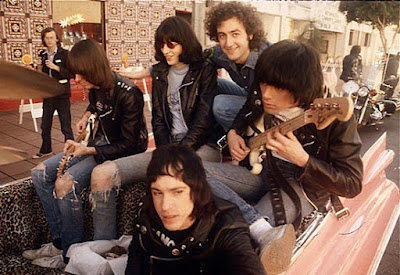
Where the 3 R's Stood for ROCK, ROLL and REBELLION!
I have heard much about this cult classic but had never actually seen it.  I knew Howard Stern bought the rights a while back and planned to remake it.  But finally I had the opportunity and I made Lisa watch it with me.  And let's just say....I was really fucking disappointed.  It was cool to see the Ramones hamming it up though. 

Originally the producers wanted Cheap Trick as the stars, but the release of the "Live At Budakon" album had just made them superstars and too hot an item to be in a low budget movie. Very good luck for the Ramones who were looking to break out of the underground punk rock world and into the mainstream market.

Will your school be NEXT?
Let me back track a bit. I was disappointed after all the build up but the film is nevertheless still reasonably entertaining.  Putting the plot, setting, and production values aside, if you are interested in what a Ramones live performance was like in the semi-early days, you should fast-forward to the scenes in this movie in which the Ramones appear. 
One thing that gave the film an added boost had to be the divine PJ Soles (better known for her performance in Halloween), who gave such a bang up performance as the peachy Riff Randell.  Which is one of the coolest names I've heard in a while.  Riff "fucking" Randell. I may name my next dog Riff.

 I'm Riff Randell, rock-and-roller.
Writing a critical review of Rock & Roll High School is like writing a food review of your local McDonalds -- you know that it's crap but that's not really the point. So okay, it's crap, but it doesn't mean that there isn't any entertainment at all.  I'm still trying to figure out the balding dude with the office in the bathroom that charged for helping the students. He'd have been in the bathroom at my high school for about 10 minutes before someone whipped his ass. 
The only thing I'll ever lay is a rug!
Trivia:
Originally, Todd Rundgren was to star as the musical act, but both sides could not come to an agreement. Next, Cheap Trick was contacted, but a similar situation happened. After that, talks were conducted with Warner Bros. Records, where Allan Arkush had a connection, to decide on which band they should use in the film. The first suggestion was Devo, but Arkush decided that they had too much of their own concept. Another band considered for the movie was Van Halen, but Warner execs warned Arkush that they were raucous and would be difficult to handle. Finally, an exec name-dropped the Ramones, who recorded for Sire Records, a subsidiary of Warner Bros. Records. Arkush, being a huge fan of the band, agreed. To this day, Rundgren regrets passing up the role he was offered.

Dee Dee Ramone was such a bad actor that his lines were cut from seven down to two, in the dressing room after the concert: "Hey, pizza!" and "Hey, pizza! It's great! Let's dig in!"

The on screen concert was attended by actual Ramones fans, whose uncontrollable, raucous behavior terrified lead P.J. Soles.

P.J. Soles had never heard Ramones before being cast in the film. She was given their music to listen to but she admits that she did not like it initially. But after her enjoyment of working with them, she became a fan of theirs.

On behalf of the students from Vince Lombardi High who are here tonight, I'd just like to say one thing: Screw you, Principal Togar, we made it to the concert anyway!
The high-school was portrayed by the non-operational Mount Carmel High School in South Central Los Angeles which had been closed-down since 1976. The building of the school blown-up at the end is the school which was scheduled for demolition. The explosion was five times bigger than it was supposed to be, and since the filming was at 3am, a lot of frightened neighborhood residents charged out of their homes, not knowing what had happened.
The Ramones were paid a total of $25,000 for appearing in the film, and had to play shows in southern California to help pay their hotel bills. During the 21-day shoot, Dee Dee Ramone got arrested for fighting with a roadie, overdosed in jail, and wound up in Cedars Sinai Hospital with a $3,000 medical bill.

During The Ramones' concert sequence at The Roxy near the end of the film, Darby Crash, late singer of seminal Los Angeles punk band The Germs, can be seen in the front row.

When The Ramones are backstage after the concert and Riff gives them her song, in the background on the wall is a picture of Cherie Currie, formerly the lead singer of The Runaways. The Runaways and The Ramones toured together.

As an inside joke regarding producer Roger Corman's notoriously stingy budget on the movie, sounds of birds going "cheap, cheap, cheap" can be heard as the New World Pictures credit appears onscreen.

The notoriously cheap Roger Corman, also a publicity genius, invited music journalists to work as extras in return for getting to be on the set and interview the principals.

Do your parents *know* that you're Ramones?
P.J. Soles purchased her own wardrobe because the film's budget was so low that they could not afford decent clothes for her. She spent her entire salary, $2100.00, on her clothes. The red satin jacket was $300.00 from Fred Segal. According to Soles, Rod Stewart was at the store and wanted to buy the jacket but she had claimed it before him.

Dick Miller improvised his line "Those Ramones are ugly, ugly people."

The origins of the film's plot were seeded in an old favorite story told to co-writer Joseph McBride by his father, the Milwaukee Journal's Raymond E. McBride, who held a walkout at the Central High School in Superior, Wisconsin during the 1920s.

On the last day of shooting, Allan Arkush was hospitalized for exhaustion, and Joe Dante was tapped to direct the remaining scenes, which were the scene in the gym where P.J. Soles sings her version of "Rock 'n' Roll High School", the long take in the bathroom, and the scene involving the telephone booth.

The romantic theme song heard under the credits, "Did We Meet Somewhere Before?" is sung by Paul McCartney and Wings. McCartney wrote it as the theme to Heaven Can Wait (1978), but Warren Beatty decided not to use it. Allan Arkush, the director, then swung a deal whereby he was able to use the song for only $500 provided McCartney did not receive screen credit.

The Ramones were recording their "End of the Century" album while working on this film.

The song 'Rock 'n' Roll High School' was changed in order to accommodate 'PJ Soles', who was unable to sing the song in its original key.

Rock Rock, Rock Rock, Rock and Roll High School...
The marijuana that Riff smokes was actually a mix of rosemary and other herbs.
The joke license plate number on the Ramones' car read "GABBA-GABBA HEY".

Hand-written posters visible on the walls during the Ear Mail sequence include a recruiting poster for the People's Temple offering free Kool-Aid and a film club poster advertising a double-feature showing of Death Race 2000 (1975) (directed by Paul Bartel) and Hollywood Boulevard (1976) (directed by Allan Arkushand Joe Dante).

Allan Arkush tried for several years to get the film produced under various rough draft titles: "High School Spirit of '76", "Heavy Metal Kids", "Girls' Gym", "California Girls", and "Disco High". After Todd Rundgren, Cheap Trick and Tom Petty declined the project, Arkush settled on the Ramones for the band in the film.

The movie's main poster was designed in a similar vogue to the one used for Animal House (1978) a year earlier. That movie had been a box-office hit. Instead of a fraternity house exploding with action and characters, this movie did the same except it was a high school main building instead.

Despite playing a high school student, P.J. Soles was 28 when the movie was filmed, and was actually older than three of the four members of the Ramones (only Johnny Ramone was older than Soles).

The movie spurred just the one sequel which was made and released around twelve years later. Rock 'n' Roll High School Forever (1991) didn't garner theatrical releases and was a straight to video movie debut.

Banner slogans for the school read "Winning is better than losing" and "Winning isn't the most important thing....It's the only thing".

Things sure have changed since we got kicked out of high school.
Mary Woronov, who plays the tyrannical Principal Togar, is only seven years older than P.J. Soles, who plays rebellious high school student Riff Randell.
Reportedly, on 31st July 2008, it was announced that Alex Winter had been hired to develop a script to remake this movie for Howard Stern.

Among the albums in Riff's bedroom that are shown are Bob Dylan's "Highway 61 Revisited", The Who's "Who's Next", The Rolling Stones' "Sticky Fingers", and The Ramones' "Road to Ruin".

His role as the School Board President marked the final film performance of Grady Sutton, ending a career that spanned almost 55 years.

While technically it otherwise has no connection to "Rock 'n' Roll High School" (and takes place in the 50's), actresses PJ Soles, Dey Young, and Mary Woronov reunited for the 1994 remake of "Shake, Rattle, and Rock". The characters they played in that film are named Evelyn Randall, Kate Rambeau Sr., and E. Joyce Togar (respectively).

The motorcycle ridden by the hall monitors was a "death machine" from the film Deathsport, which executive producer Roger Corman had produced and directed the previous year.

Rob Bottin: Uncredited, the special-effects and make-up artist as a giant white mouse / Mrs. Mouse.

Joe Dante: Uncredited, the director as a riot cop with sunglasses.

Allan Arkush: Uncredited, as a ticket-taker in a green shirt.


Tuesday, February 26, 2019

Crippled Kung Fu Boxer (1979)


Kung fu genius (Cliff Lok) stars as the student of a famous kung fu master whose kung fu gym gets overrun by the Hunchback and his gang, Cliff runs off and seeks refuge with his uncle, who teaches Cliff the art of the Crippled Fist so he may take revenge of the Hunchback and the rest of his vile posse.

I watched this film under the title CRIPPLED KUNG FU BOXER, which is an appropriate title unlike NINJA SUPREMO, a later re-titling for VHS release during the ninja boom of the mid 1980s. As there are no ninjas in this production, that title is a misnomer while CRIPPLED KUNG FU BOXER is more than appropriate. The story stars Cliff Lok as an idealistic young kung fu student whose master gets into trouble when he encounters some sinister, physically-deformed criminals.


It starts with two against one fighting over hidden money. Cut to Cliff Lok practicing the three section staff. The one armed swordsman barges in and challenges Suen Yuet who "fights" him. Then a spearsman barges in for another challenge. Cliff Lok flips from master to master according to the winner. His father laments how the son is only interested in martial arts. Cliff takes his spearsman master to the brothel and offends about four men. They follow him home and Cliff is forced to flee. The four turn against the father but another master arrives and rescues him. Cliff has his fish dinner stolen by a monkey then hooks up with a "cough" master and a kung fu chick.
Dude, my fucking hands won't stop shaking. 
This movie has a ton of training, right up until the final fights. And the final 2 fights take up the last 20 minutes of the movie. Ma Chin Ku and Choi Wang are the villains, and they really get to shine. They are crippled at the start of the movie, and come back for revenge at the end. Ma Chin Ku is a hunchback, and Choi Wang holds his hands out awkwardly in front of him and his hands are always shaking.
Just when you think the film is over and you think you've seen it all, a fighter with cerebral palsy shows up and the story gets even weirder and borderline offensive. Still, at least it's unique...


Killer Clans (1976)

Two clans compete for dominance over the martial arts world in this classic of violent swordplay and political intrigue. A complex tale of deception and double crosses. Killer Clans leaves viewers guessing every step of the way. Masterful fight choreography from Yuen Cheung Yan (Yuen Clan member and brother of Yuen Woo Ping) and Tong Gaai fills the screen with bloody sword fighting and imaginative weaponry, delivering both great drama and fantastic martial arts.

Killer Clans is a masterful big-budget costume drama from Hong Kong's Shaw Bros. studio that is quite a change from the usual SB martial arts extravaganzas of the 1970s. It's closer in tone to Japanese samurai films of the 1960s and boasts a formal aesthetic beauty that was not often found in HK swordplay films. The sets are quite spectacular as are the costume design and art direction.

Based on a novel by famed martial arts chronicler Ku Lung, the plot has to do with clan warfare between the Lung Men Society and the power-hungry Roc Society in Old China. Various characters are not exactly what they seem as clan loyalties shift and major characters betray lifelong comrades. There are many surprising plot twists that would be best left undescribed here. Swordfights erupt every so often, although they are shorter affairs than usual for a Shaw Bros. swordplay film and place less of an emphasis on martial arts technique. The film's dramatic stress is on the interplay between the various characters and the alliances they form rather than on the action per se. The fight scenes, staged by Yuen Cheung-Yan, remain, however, consistently exciting.


The large cast includes some major players from 1970s Shaw Bros. films, most notably Ku Feng, normally a villain, but seen here as the durable and crafty head of Lung Men, whose survival efforts are quite impressive. His character is clearly the dominant one and his performance outshines those of the two younger male leads, Chung Wa, who plays a freelance swordsman whose loyalties become a major issue as the film proceeds, and Yueh Hua, who plays Ku Feng's second-in-command. Other familiar performers are on hand and are seen to good effect, including Wang Chung, Lo Lieh, Yeung Chi Hing, Norman Chu, future star Danny Lee (CITY ON FIRE), and actresses Li Ching and Chan Ping (as a lusty femme fatale who disrobes for some surprising nude scenes). The portly Fan Mei Sheng, usually seen in comic supporting roles, plays a family man who is at the center of a moving, intense scene late in the film that is truly one of the film's dramatic highlights.


KILLER CLANS was directed by veteran filmmaker Chor Yuen (SACRED KNIVES OF VENGEANCE, IRON CHAIN FIGHTER), who displays an assured and restrained touch that's quite a departure from the more frenetic direction found in the Shaw Bros. martial arts films directed by Chang Cheh (FIVE MASTERS OF DEATH, BLOODY AVENGERS). For one thing, there's not a zoom lens in sight! The director also avoids the more theatrical, Chinese Opera-style staging found in the films of his contemporary, King Hu (A TOUCH OF ZEN). While Chang Cheh's films tended to be less demanding and more entertaining, KILLER CLANS is ultimately a richer, deeper film and more satisfying on a dramatic and artistic level.


"Killer Clans" is not a perfect kung fu film. It's a very inconsistent one overall in pacing and acting (allowing Ku Feng to act circles around his co-stars as the brilliant chess player Uncle) and the random bits of nudity feel massively out of place. It is, however, very entertaining with its crazy complex story and some fun fight sequences choreographed by Yuen Cheung Yan (yes, that's the brother of legendary fight choreographer Yuen Woo Ping). It does earn some credit with its charm that makes some of the weirder elements less of a burden. For kung fu fanatics, "Killer Clans" comes recommended for its entertainment value even if Chor Yuen has done better.


Theatrical Run:  3/20/1976 - 4/2/1976
Box Office:  HK - $1,596,557.20