Translate

Monday, October 31, 2016

Under The Skin (2013)

A mysterious woman seduces lonely men in the evening hours in Scotland. Events lead her to begin a process of self-discovery.

Under the Skin is a 2013 science fiction film directed and co-written by Jonathan Glazer loosely based on Michel Faber's 2000 novel of the same name. The film stars Scarlett Johansson as an otherworldly woman who preys on men in Scotland.

This is a weird fucking film.  

Firstly, there is no obvious narrative in this film, because it does not have a big significance or importance here. On the most basic level it is a story of an alien imposing a woman and seducing men from all over Scotland in order to drain their flesh. This is the most simple summary of the movie. On deeper layers it is a serious study of our society. The film's main focus is on the inside and outside of things, the philosophy of form and material. Johansson's character is struggling in this society. She is always portrayed as going against the stream, she is lost in the sea of rushing people who do not want to get deeper into things, because they know they could be hurt. This is represented in a very subtle visual way. For instance, roses look nice in the film, but they have spikes which make rose seller's hands bleed. A piece of cake seems delicious, but the taste of it is disgusting. It is always the fight between the surface and depth in this film, the first impression and further investigation. I believe it is a very important theme for our society where people are afraid of making commitments or engagements, where they seek for quick pleasures, even though they need true and honest love. The film is very strong visually and stylistically. In order for the reader to get a glimpse of what it is, I will say that it is sort of a combination of Kubrick, Lynch and von Trier.

What's Under The Skin
Scarlett Johansson doesn't have a lot to do in this film; basically make small talk and get naked, all the while with a plain face.  You have never seen a movie even remotely like this.  
"Under The Skin" is unique among films in content and scope. The cinematography is out-of-this-world, breathtaking, and the musical score is sublime. Jonathan Glazer's "Under The Skin" is art in the highest sense, like Leonardo da Vinci's "Mona Lisa", or Vincent Van Gogh's "The Starry Night". The film requires you to watch in a different way than you normally watch films. It requires you to experience strange and beautiful images without feeling guilty that there is no complex plot or detailed characterization. Don't get me wrong, plots and characters are good, but they're not the be-all and end-all of everything. There are different KINDS of film, and to enjoy 'Under The Sin' you must tune your brain to a different wavelength.


Why should you see this movie? Because it's really beautiful, shows you visuals you've never seen before, tells a tragic mystery without burying you in exposition, and holds an absolutely unselfconscious confidence. It shows beauty and ugliness as a matter of fact, without constantly checking to make sure we grasp which is which. It uses special effects to quietly augment reality and paint the fantastic into the corners of ordinary scenes. It may leave you weirded out and uncomfortable.

A truly unique film. A truly weird as fuck unique film.

Hi Sean.
Trivia:
The men lured into the van by Scarlett Johansson's character were not actors. Jonathan Glazer had hidden cameras installed in the van and only informed the men afterwards that they were in a movie.

Adam Pearson, who plays the disfigured man who is lured into the vehicle, broke his leg when he was struck by a cab on his way to audition for his role. Director Jonathan Glazer auditioned him the next day at the hospital and gave him the job.

Scarlett Johansson did the nude scenes herself without the use of a body double. Which should really be of interest to Sean.

Close to the end one of the motorcycle riders overlooks a valley shrouded in fog. The composition of the image and the pose of the rider mimics Caspar David Friedrichs 1818 oil painting Wanderer above the Sea of Fog.

The film took nearly 10 years to be made, and one of the early drafts of the scripts included a Scottish married couple, who were revealed to be aliens in disguise. Brad Pitt was, at the time, cast as one half of the couple.

Just cruising looking for Sean
A paparazzi still of Scarlett Johansson, in character, falling down became a wildly popular Internet meme in which users would Photoshop Johansson into various situations. As the scene was shot with hidden cameras, it was not until the movie's release that it was revealed the fall was intentional.
Championship motorcycle road racer Jeremy McWilliams was cast as the motorcyclist to handle the treacherous driving conditions of the Scottish Highlands.

The nightclub that Scarlett Johansson gets pulled into is Club Earth in Livingston, West Lothian. Although the exterior shots & many of the interior shots are of the actual club, her escape route & scene in the toilet corridor seem to have been filmed elsewhere.

The first proper line of dialogue happens 13 minutes into the film.

One of the locations where Under the Skin was filmed was in the Robert Street area of Port Glasgow. (Where the second victim is lured). Filming had to be delayed for a number of days as there was a real life murder in the next street prior to filming and the Police had cordoned the area off.

Novelist and screenwriter Alexander Stuart ("The War Zone") wrote the first three drafts of the script.


The scene where Scarlett enters the stone hut for shelter was filmed on the eastern shores of Loch Lomond. It was filmed over two days. The cast and crew had to be taken by boat from Tarbet to the set as there is no road access. The only access is a footpath known as the West Highland Way.

In August 2014, Mr. Skin placed Scarlett Johansson's nude scenes from the movie at #1 on their list of "The Top 150 Greatest Celebrity Nude Scenes of All Time".

There is only one character in the entire film that has an actual first name being "Andrew". Every other character is just a broad description like "The Female" or "The Bad Man".

Like The Terminator (1984) films, The Female arrives on Earth bare naked and takes and wears another woman's clothes.

Scarlett and my cousin Brian. No makeup on him,.
One theory suggests that The Female is actually a Selkie instead of an alien. Selkies are mythological creatures found in Scottish, Irish, and Icelandic folk lore. Selkies are said to live as seals in the sea but shed their skin to become human on land. Selkies are described as being very beautiful in their human form and therefore having great seductive powers.
Adam Pearson (The disfigured man) was interviewed on the Australian morning talk show "Studio 10" about the film and had stated the scene where he runs naked through a field in Scotland was filmed at 3 in the morning and that it was so cold.

After finishing work on the film. Scarlett Johansson would start work on two other science fiction films: Lucy (2014) and Avengers: Age of Ultron (2015).


Rebel Without A Cause (1955)

A rebellious young man with a troubled past comes to a new town, finding friends and enemies.

Rebel Without a Cause is a 1955 American drama film about emotionally confused suburban, middle-class teenagers filmed in CinemaScope. Directed by Nicholas Ray, it offered both social commentary and an alternative to previous films depicting delinquents in urban slum environments. The film stars James Dean, Sal Mineo and Natalie Wood.

Jim Stark (James Dean) is a lonely desperate teenager, who supposedly hasn't a friend in the world when we first see him lying drunk in an L.A gutter... But his personality is such that within a twenty-four-hour period he makes friends with Plato (Sal Mineo) and Judy (Natalie Wood), two misunderstood teenagers completely different from each other and himself...

Chilling like a villian
This movie is just as powerful as it was 50 years ago. Inside the cheesy braggadocio of an angry gangster is a confused kid. I can't think of a single person that did not feel alienated as a teenager. James Dean represents what every teenager would want to be. Individualistic: has a set of values and sticks to them Brave: engages in activities most of us would never consider (esp. chicky run) Kind: caring to Plato and Judy.
What's particularly satisfying about the film is its cohesiveness, binding together its many disparate events and characters with highly parallel themes and motifs. All of its central characters seem caught in psychosexual conflicts rife with familial gender conflict. Jim (James Dean) is caught between a weakling, effeminated father and a domineering but inneffectual mother. Judy (Natalie Wood) and her father are seperated by his uncomfortable relation to her sexuality. Plato (Sal Mineo), worst of all, is a practical orphan, who suffers all the more for his just under the surface homosexuality. (It's interesting to note here that Plato may be Hollywood's first sympathetic of a gay character.) All of them are driven by internal demons springing from these conflicts.

The supporting cast include Jim Backus as James Dean's well-to-do yet wimpish and henpecked father as well as a young Dennis Hopper as a member of a greaser gang. Jim Backus of course was Mr. Howell on the TV show Gilligan's Island. His ass has appeared in several films I've watched recently. 
Mr. Howell secretly dresses as Lovey
It wasn't only James Dean's tragic death that made him a legend. He was getting acclaim for his performance in East of Eden when he was killed on September 30, 1955. His stunning impact came after his death as fans were mesmerized by the promise of things to come in Rebel Without A Cause which came out about four weeks later and with Giant which Dean had just wrapped shooting on. This dead actor had film fans talking everywhere right up to the Oscars of 1957 ceremony where he was nominated for 1956's Giant. If ever a player left the scene with fans begging for more it was James Dean.
Nicholas Ray directs this picture in an almost surreal way. Bright, sunny scenes outside are contrasted with cold, dark interior shots. The camera mirrors the story and the spirit of the film in quite a unique way. When we see Jim, drunk out of his mind, lying on the cold street, the camera stares unflinchingly, never looking away. When Jim argues with his parents in a particularity dynamic scene, the camera seems distorted, out of place. Even when our three main characters escape to their ultimate fantasy, alone with each other outside of everyone and everything else, they are shrouded in darkness.

Seen today over 50 years later Rebel Without A Cause still remains the ultimate film in teen angst. I think it's destined to be so for generations to come.

If you pull a knife it better have some ketchup on it because you're going to eat it.
Trivia:
The part where Jim and Judy find Plato wearing one blue sock and one red sock was not scripted. Sal Mineo actually put them on that way by mistake.

T-shirt sales soared after James Dean wore one in this film.

James Dean died on September 30, 1955, nearly a month before this film was released on October 27, 1955.

The opening scene in the movie with Jim Stark and the toy monkey was improvised by James Dean after the production had been shooting for nearly 24 hours straight. He asked Nicholas Ray to roll the camera, that he wanted to do something. Ray obliged and the improvisation went on to become the famous opening scene.

The whole film takes place over 24 hours. The opening scene in the police station take place around 3am. The ending scene takes place around 3am the next day.

All three lead actors, James Dean, Sal Mineo, and Natalie Wood, died prematurely under tragic circumstances; Dean died in an automobile accident in September 1955, Mineo was stabbed to death on February 12, 1976, and Wood drowned in the late autumn of 1981. In addition, Edward Platt committed suicide in 1974 and Dennis Hopper suddenly fell terminally ill in the fall of 2009 and died five months later.


James Dean was free to star in the film because Elizabeth Taylor got pregnant, which delayed production of Giant (1956).

Natalie Wood was first considered too naive and wholesome for the role of Judy. She began changing her looks and eventually attracted the notice of director Nicholas Ray, who began an affair with her but still would not guarantee her the part, though he eventually relented. Both Ray and Wood later claimed that he changed his mind after she was in a car accident with Dennis Hopper and someone in the hospital called her a "goddamn juvenile delinquent". Wood soon yelled to Ray, "Did you hear what he called me, Nick?! He called me a goddamn juvenile delinquent! Now do I get the part?!"

The empty pool in which the characters sit and discuss their lives first appeared in Sunset Boulevard (1950). The pool had been built specially for the earlier film, as a condition of renting the site from its owner, Mrs J. Paul Getty.

Jim Backus who played James Dean's father and was the voice of Mr. Magoo, taught Dean how to do the Mr. Magoo voice which Dean then used to deliver the line, "Drown them like puppies."

Originally in the beginning of the movie, there was a gang beating up a father, who drops a toy on the sidewalk. The studio thought it was too violent, so it was cut. Jim Stark can be seen playing with the toy after he finds it on the ground during the opening credits


The film was originally going to contain a kiss between James Dean and Sal Mineo.

The movie's line "You're tearing me apart" was voted as the #97 of "The 100 Greatest Movie Lines" by Premiere magazine.

James Dean badly bruised his hand during the police station scene where he physically vents his rage on a precinct desk and had to wear an elastic bandage for a week.

Although playing a teenager, James Dean was actually 24 when the movie was filmed. Natalie Wood and Sal Mineo, however, were of the right age.

Director Nicholas Ray researched L.A. gangs by riding around with them for several nights.

The movie was originally to be shot in black and white, and some scenes had already been filmed that way, when the studio decided to switch to color. The official explanation at the time was that Twentieth Century-Fox, which owned the wide-screen CinemaScope process, had ordered that all films shot in the process had to be in color, but some also believe that Warners ordered the switch to head off comparisons with Blackboard Jungle (1955) and because James Dean's increasing popularity gave the film more prestige.

Frank Mazzola, who plays "Crunch" in the film, was an actual street gang member when he was a student at Hollywood High School. He was a member of a gang called "The Athenians." As such, he served as a technical advisor to Director Nicholas Ray and coached other actors in regard to street gang attitudes and mannerisms.


Jim Stark was actually first intended to be more of a nerd, wearing a brown jacket and glasses. However, when Warner Bros. told director Nicholas Ray to re-shoot in color, Ray, as well as costumer Moss Mabry, wanted him to wear red.

Originally based on a non-fiction work by Dr. Robert M. Lindner, about the hypno-analysis of a young criminal. Producer Jerry Wald intended to make a film of the work and commissioned several scripts, including one by Dr. Seuss (Theodore Geisel), and Marlon Brando was set to star at one point, but the project was eventually shelved. When the studio bought Nicholas Ray's treatment "The Blind Run" it asked him to use the title of Lindner's work, but the film doesn't include anything else from the book.

The writing credits for the film are as follows: Stewart Stern (screenplay), Nicholas Ray(story) and Irving Shulman (adaptation). In an interview, published in Michigan Quarterly Review in 1999, Stern, however, claims that he had never even seen "The Blind Run", the treatment for "Rebel" supposedly written by Ray. The screenwriter says he was shocked when he learned that the director wanted to take the sole story credit as there had not been an actual story before he started writing the script. Stern admits that both Ray and Shulman had contributed to the story therefore he believes that the credit should have been divided between the three of them. Later, the film received an Oscar nomination for the story alone with only Ray being nominated for writing.

James Dean originally wanted his friend Jack Simmons, whom he was living with at the time, for the part of Plato.


Dennis Hopper and Natalie Wood had a brief relationship during filming. Wood also had an affair with Nicholas Ray, which was scandalous due to the fact that she was only 16 while he was 43 and older than her father.

In the police station scene, while the adults are talking to the cop, Jim keeps whistling Wagner's Ride of the Valkyries, a classical piece known to audiences because of its memorable use in Apocalypse Now (1979). Dennis Hopper appears in both films.

Realizing the actor's power to touch youthful audiences, Nicholas Ray gave James Dean free reign to improvise his scenes. The cast often took its cues not from Ray, but from the Method-acting entranced Dean.

James Dean did not get malaria during filming, as some have reported. Nick Adams had a relapse of an old case of malaria he got while he was a merchant marine.

The 1949 Mercury Coupe James Dean drove in the movie is part of the permanent collection at the National Automobile Museum in Reno, Nevada.

When the crew began night shooting at the Griffith Park Planetarium in Hollywood, downtown Los Angeles residents saw the bright production lights in the hills and flooded switchboards with reports of raging forest fires.

James Dean got angry when Nicholas Ray stopped the knife fight scene after noticing that James had been cut on the ear and was bleeding. Dean said:"Don't you ever cut a scene while I'm having a real moment."


In Gilligan's Island: Castaways Pictures Presents (1965), Thurston Howell III, cries out, "Method actors! Never again!" as he directs the castaways in film production. This may be an inside joke in reference to James Dean. Jim Backus played Frank Stark in this film and had scenes with Dean that turned physical as a result of Dean's legendary and infamous spontaneous, method acting style.

The switchblade that James Dean used in the fight scene at Griffith Observatory was offered at auction on September 30, 2015 by Profiles in History with an estimated value of US$12,000 to $15,000, with a winning bid of US$12,000.[10] Also offered at the same auction were production photographs and a final shooting script dated August 17, 1955 for a behind-the-scenes television promotional film titled Behind the Cameras: Rebel Without a Cause hosted by Gig Young and that had scripted interviews and staged footage by the cast and crew (script winning bid US$225.)

Sal Mineo once said that on the day his death scene was shot, James Dean never let Sal out of his sight during the entire day.

For the knife fight between Jim (James Dean) and Buzz (Corey Allen), the actors used real switchblades and protected themselves by wearing chainmail under their vests.

An alternative ending was shot in which Plato falls from the tower of the planetarium.

In the final scene where the camera pulls away from the observatory, director Nicholas Ray is the person walking toward the building. (possible director's trademark for it is rumored he appeared in all of his movies)

The "chickie run" was staged at a Warner Bros. property in Calabasas, California. The cars drove on flat land that led to a small bluff of only 10 -15 feet high. The cars drove over the small bluff, but the "cliff" supposedly overlooking the ocean was built on Stage 7 (now Stage 16) at the Warner Bros. Studios in Burbank. The constructed cliff overlooked the stage's flooded water tank and the actors looked down upon the water from the edge. Even so, it became necessary to matte in shots of the Pacific Ocean in the final product.


Thursday, September 15, 2016

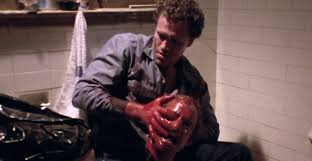
Henry: Portrait Of A Serial Killer (1986)


Henry, a drifter, commits a series of brutal murders, supposedly operating with impunity.

Henry: Portrait of a Serial Killer is a 1986 American psychological horror crime film directed and co-written by John McNaughton about the random crime spree of a serial killer. It stars Michael Rooker as the nomadic killer Henry, Tom Towles as Otis, a prison buddy with whom Henry is living, and Tracy Arnold as Becky, Otis's sister. The characters of Henry and Otis are loosely based on real life serial killers Henry Lee Lucas and Ottis Toole.

"Henry" is disturbing on many levels. Firstly, it feels very real. Too real, perhaps. Nothing is slicked up...nothing seems counterfeit or contrived. The entire thing is so utterly plausible that it chills you to the bone. "Henry" doesn't bother with any type of morality...it neither glorifies nor denounces Henry's actions. It simply observes. It places those actions before us and says "there it is...you deal with it...you sort it out."

The movie follows the exploits of Henry, a young man who is practically a textbook case of a serial killer (male, white, 30's, drifter, soft-spoken, shy). Conflict comes when his disgusting nasty inbred cousin Otis Toole stays with him, along with his pathetic sister. One night Otis and Henry pick up a couple of prostitutes and are having sex with them in the car. Henry kills both of them sort of offhandedly, with no more emotion than you would swat a fly. Otis starts joining him on his exploits. Henry is more sympathetic than Otis, however, because while Henry does these things because he is sick and doesn't have a choice, Otis seems to get off on them, and also should know better. Things sorta go downhill from there, and the sister complicates things because she is so desperately lonely that Henry starts to look good to her. It culminates in one of the most chilling, downbeat endings of all time.

Michael Rooker, still a novice actor at this point, is amazing. He comes across as somehow dumb yet clever, unable to read but able to get what he needs. This fits the redneck killer profile of his character, and is so convincing you woud think Rooker himself was a little bit dumb or slow if you had not seen him in other roles

Henry is a brilliant film. Well acted and brilliantly conceived. It isn't an easy film to sit through but often the most challenging works of art aren't. Kudos to Rooker and McNaughton for taking this subject matter with utmost sincerity. Violence is either glorified on one extreme or attacked viciously on another. 'Henry' is an honest look at the capabilities and evil power violence has. It's a powerful, shocking, raw, brutal movie that, while often difficult to watch, is impossible to ignore or forget.

Yeah, I killed my Mama...
Trivia:
Actor Michael Rooker remained in character for the duration of the shoot, even off set. He didn't associate or socialize with any of the cast or crew during the month long shoot, and director John McNaughton made sure Rooker was the only person on set to have a private dressing room. According to costume designer Patricia Hart, she and Rooker would travel to the set together each day, and she never knew from one minute to the next if she was talking to Michael or to Henry as sometimes he would speak about his childhood and background not as Michael Rooker but as Henry. Indeed, so in-character did Rooker remain, that during the shoot, his wife discovered she was pregnant, but she waited until filming had stopped before she told him.

The film was shot on 16mm in 28 days with a budget of $110,000. It initially earned $600,000 on its (extremely limited) theatrical run, but has since gone on to earn millions on VHS and DVD, as well as theatrical re-releases.

The music for the film was mixed in a recording studio in Chicago run by rock n' roll Christians. According to director John McNaughton, they were quite shocked when they saw the film.

Although the MPAA initially gave the film an X-Rating, this movie, along with Peter Greenaway's The Cook, the Thief, His Wife & Her Lover (1989) and Pedro Almodóvar'sTie Me Up! Tie Me Down! (1989), were the main reasons for the creation of the NC-17 rating (an adults-only film which is non-pornographic).
He's not Freddy. He's not Jason. He's real.
The scene in the living room where Otis (Tom Towles) films Henry (Michael Rooker) and Becky (Tracy Arnold) with the camcorder was completely improvised by the three actors.

Michael Rooker said he was working as a janitor when he auditioned for the part of Henry and went to the audition in his janitor uniform. He got the part, and continued to wear his uniform throughout the film shoot. He only had one jacket, though, so he took it off before he "killed" anyone so he wouldn't get blood on it.

Many of the insults which the TV sales man (Ray Atherton) shouts at Henry and Otis (eg "I can see you've had some college") were improvised on-set by Atherton himself.

During its release limbo, tapes circulated around Hollywood which won many roles for Michael Rooker including one in Eight Men Out (1988).

Dude watches his TV up to close
Although completed in 1986, the film didn't get a theatrical release until 1989. It is often mistakenly claimed that this was due to its being tied up in censorship issues with the MPAA, and although this is true to a degree, the majority of the delay occurred because the executive producers, Malik B. Ali and Waleed B. Ali were somewhat underwhelmed by the film turned in by director John McNaughton, and weren't sure it was even worth their time releasing it on VHS, let alone releasing theatrically. As McNaughton himself says, "they just put it on the shelf". Several years later, Chuck Parello (who would go on to direct Henry II: Portrait of a Serial Killer (1996)) saw the film and was deeply impressed. Parello was working for the Ali brothers at the time, and he began to lobby them to do something with it. He convinced them to let it be screened at the Chicago Film Festival in 1989, where, after getting a glowing review from the Chicago Tribune's Rick Kogan, the film was accepted into the 1989 Telluride Festival and subsequently the 1990 Splatterfest Festival, becoming the sensation of both festivals. At this point, the Ali brothers realized they had something unique on their hands and set about promoting the film for theatrical release.

Even members of the film making team themselves have been disturbed by the film. Composer Robert McNaughton couldn't watch the film right the way through upon first seeing it, and actor Tom Towles (Otis) has only ever seen the film once, at the Splatterfest Film Festival in 1990.

The four murder scenes seen in the first few minutes of the film were all based on real life murders which Henry Lee Lucas claimed to have committed, especially the first shot, where the body of the nude woman is posed in exactly the same position as a victim in a case involving Lucas.

Director John McNaughton and actor Tom Towles both considered the character of Otis to be a comic buffoon, and they consciously presented the character in a darkly humorous manner. Interestingly, Towles, a former US marine, formal training was in improvisational comedy, not dramatic acting.

Before "The Silence of the Lambs" comes the most highly acclaimed and controversial film of the year."
Actor Tom Towles initially auditioned for the role of Henry, before director John McNaughton asked him if he'd be interested in playing Otis.

When the film was submitted to the BBFC for classification in 1990, distributor Electric Pictures removed the shot of the dead woman on the toilet without consulting director John McNaughton because they felt it would predispose the BBFC to look on the film as an exploitation piece and not a serious film.

Director John McNaughton originally intended to shoot the entire film with a hand-held camera, so as to give it the look and feel of a fly-on-the-wall documentary. He had hired Jean de Segonzac to work as the director of photography as de Segonzac was regarded as one of the world's foremost hand-held cameramen. However, a week before filming began, de Segonzac had to drop out of the project, and McNaughton was left without a director of photography. He subsequently hired Charlie Lieberman, who had shot a number of half hour substance abuse programs, and together, McNaughton and Lieberman decided to abandon the hand-held idea and go in the opposite direction; never using a hand-held camera at all, and ensuring very exact, very rigid framing throughout the film.

Producer/composer Steven A. Jones was paid $100 for his 14 months work on the film.

The song playing in the background when Otis tests out the new video camera is "Psycho" by The Sonics.

Entertainment Weekly ranked this as the 16th scariest movie of all time.

During the screening of the film at the 1989 Telluride Festival, nearly half the audience walked out during the family massacre scene. When the film finished, it was met with complete silence, as the audience were so stunned by what they had just seen and didn't know how to react. As director John McNaughton was leaving the theatre, he was approached by a distressed man who informed him: "You can't do that". McNaughton asked him what he meant, and the man explained that you couldn't make a film about a murderer who gets away in the end, without punishment or without any kind of moral resolution, reiterating "You can't do that". McNaughton thought about this for a moment, and then said to the man: "We just did".

Throughout the film, any sound of a neck breaking is really a Styrofoam cup being crushed near the microphone. The sound of Henry (Michael Rooker) cutting off Otis' (Tom Towles) head is a plastic mesh grapefruit bag being slowly torn open.

When Otis (Tom Towles) attempts to rape Becky (Tracy Arnold), he begins to choke her with an item of clothing. During the filming of this part of the scene, Arnold passed out for real.

After filming the family massacre scene, actor Tom Towles (Otis) insisted that actress Lisa Temple (who plays the mother) go to the casualty department because he was convinced he had injured her neck for real when he snapped it. Temple herself was confident that no damage had been done, but for Towles' peace of mind, she did go to casualty, where she received a clean bill of health. Over time, this story has evolved into an urban myth that Temple had to go to the hospital because she was traumatized by the scene, the content of which the filmmakers had concealed from her prior to shooting. As she herself tells it in Portrait: The Making of 'Henry' (2005), there is no truth in this story whatsoever. She went to the hospital purely as a precaution.


The fake head of Tom Towles used in the scene where he is stabbed in the eye cost $700.

The film makes use of many uninterrupted takes. The scene when Henry and Otis drive through the night and kill the man who stops to help goes on for almost two minutes without a single interruption.

The character of Henry is loosely based upon the real life serial killer Henry Lee Lucas. As in the film, Lucas was acquainted with a fellow convict named Ottis Toole (although in the film, the character's name is only given as Otis). Additionally, Lucas became the lover of Toole's 11 year old niece, Frieda Powell, who lived with Lucas and Toole for a time and often went under the pseudonym of "Becky" (although in the film, Becky is Otis' sister, rather than his niece, and is considerably older than Powell was). Also as in the film, Lucas ultimately killed Becky. Furthermore, like the fictional Henry, the real Henry's mother worked as a prostitute from her house, often forcing him to watch her whilst she had sex, and occasionally making him wear a dress. The real Henry's father had also lost both his legs in an accident, prior to which he had been a truck driver, just like the fictional character. However, the actions of the fictional Henry are inspired not by Lucas' real crimes, but by his fabricated ones. In prison, Lucas confessed to over 600 murders, claiming he committed roughly one murder a week from 1975 to 1983. Ultimately however, the vast majority of these claims turned out to be false, whilst many of the rest could not be substantiated one way or the other. Lucas was simply confessing to every unsolved murder brought before him because doing so ensured better conditions for him, as law enforcement officers would offer him incentives to 'confess'. Such confessions also increased his fame with the public. In the end, Lucas was convicted of eleven murders, and sentenced to death for the murder of Frieda Powell, although his death sentence was later commuted to life in prison by the then governor of Texas George W. Bush.


The scene where the salesman (Ray Atherton) has the TV smashed over his head was filmed in reverse with Michael Rooker pulling the prop TV away from Atherton's head.

Throughout filming, the filmmakers cut costs by utilizing family and friends, as well as their own possessions, and even the crew itself, wherever they could. For example, the dead couple in the bar near the start of the film are the parents of director John McNaughton's best friend, whilst the bar itself is where McNaughton used to work.. Actress Mary Demas (a close friend of McNaughton's prior to the film) plays three different murder victims; the woman in the ditch in the opening shot; the woman with the bottle in her mouth in the toilet; and the first of the two murdered prostitutes. The four women Henry encounters outside the shopping mall were all played by close friends of McNaughton. The woman hitch hiking was a woman with whom McNaughton used to work. The clothes Michael Rooker wears throughout the film were his own clothes (apart from the shoes and socks). The car driven by Henry belonged to one of the electricians on the film. Art director Rick Paul plays the man shot in the lay-by; storyboard artist Frank Coronado plays the smaller of the attacking bums; grip Brian Graham plays the husband in the family-massacre scene; executive producer Waleed B. Ali plays the clerk serving Henry towards the end of the film.

In the original script, the family massacre scene is longer. After the three family members have been murdered, Otis (Tom Towles) molests the body of the mother (Lisa Temple) and performs full necrophilia with it. Prior to shooting however, director John McNaughton made the decision to abandon this part of the scene.

Henry Lee Lucas died in prison on March 13, 2001 of heart failure.


3 Extremes (2004)


An Asian cross-cultural trilogy of horror films from accomplished indie directors.

3 Extremes is a 2004 international East Asian horror film collaboration consisting of three segments by three directors from three countries.  

This movie is incredibly cruel and unrelenting. It plays as a single feature divided into three sections: "Dumplings", directed by Fruit Chan of Hong Kong, "Cut" directed by Park Chan-Wook of Korea and "Box" directed by Miike Takashi of Japan. Each section is like a dissertation in horror, although "Dumplings" could also be classified as an exploitation film.


The first story is Dumplings. It's very very disturbing and pretty gruesome. Not because of gore or anything like that, but because of the subject matter. It's no secret or spoiler that this movie is about vanity and a women's need to enhance her physical appearance to try and win her husband back from his whoring around. It concerns as most of you know, the grisly meat a former lady abortionist uses to treat her rich clients vanity needs. This movie made me squirm on more than one occasion as the woman chomps down on the dumplings with a wicked crunching sound of tiny bones.  


Cut is up next. Now this is one gruesome story, which revolves around a movie director (Lee) and a former extra of his that's gone completely insane and terrorizes the director and his wife at their home. Park's short story touches on adultery, relationships, regret, fame and childhood memories - as well as featuring amputation, torture, child abuse, and a crazy set - as Lee and his kidnapper spar until the shocking (but not altogether satisfying) end. In fact, the ending is the only bad part about this otherwise intriguing story. This is the most graphic of the three stories, and the most brutal. But the twists and turns that happen towards the end, tend to confuse the whole story.


Up last is Box: This is a nightmarish tale of a woman's horrifying dreams becoming reality, but then again, maybe not. That's the difficulty with this story, there is so much surrealism, that it's hard to tell. I liked the story, some of which was very frightening. The ending however is completely totally bizarre, and it totally left me clueless as to what Miike intended for the viewer to take away from this, if anything. This is the weakest of the three stories, but still very interesting and definitely requires multiple viewings.

If you like slasher movies and jump out of your seat scary, pass on these. If you like more artistic, intelligent, and subtle horror films, then these shorts are for you. Some blood and minor amounts of gore. A job well done. I highly recommend this film to anyone who is tired of watching horror films marketed for little kids. If you are searching for something artistic, horrifying and with something to say, then by all means indulge yourself in "Three Extremes" a fine example of how Japanese Horror is kicking American Horror firmly in its ass.


Macabre (1958)


A doctor's daughter is kidnapped and buried alive, and he is given just five hours to find and rescue her.

Macabre is a 1958 thriller film directed by William Castle, written by Robb White, and starring William Prince, Jim Backus, Christine White, Jacqueline Scott, and Susan Morrow. The film falls into both horror and suspense genres.  

Dr. Rod Barrett's (William Prince) young daughter has been kidnapped by a mysterious maniac who has buried her alive "in a large coffin". The doctor has five hours in which to find and rescue her before her air runs out and she suffocates. The maniacal killer apparently also murdered Barrett's wife and her sister.

Various family members and friends become potential suspects as they help in the search, wandering through dark graveyards, crypts, thunder and lightning, and red-herrings. The somewhat muddy plot leads to a surprise conclusion that reveals the guilty party and the motive. At the film's end, a narrator requests that the audience not reveal the unexpected ending to others.

$1000,00 in case of DEATH by FRIGHT
William Castle's first excursion into the horror genre is not really scary at all. It's a mild murder mystery about several dislikable characters, one of them presumably having committed a grizzly crime. It gets bogged down midway with some flashback sequences which really don't help the narrative THAT much. The performances are well acted and the film manages to keep a decent level of intrigue and curiosity throughout. It's also unusual to see Jim Backus in a rather unlikable role. In case you don't know who Jim Backus was.....he's fucking Mr. Howell from Gilligan's Island and he's a huge dick in the film. He was Mr. Magoo as well. 

The cast is fine although Jacqueline Scott (in her film debut) is a little over the top for my tastes. Christine White is good in flashback scenes ("All men seem alike in the dark"). The scene implying she wants an abortion is pretty taboo stuff for 1958, even if the word itself is never uttered. Castle's direction is adequate. There's some decent atmosphere in the graveyard scenes but not much tension, due in part to the cutaways for flashbacks. 

Mr Howell meets Lovey
The ending is still a grabber that I didn't see coming even if I couldn't quite figure out the logic. Anyway, with more work on the screenplay, this could have been something memorable instead of the okay thriller it is. 

IF IT FRIGHTENS YOU TO DEATH - YOU'LL BE BURIED FREE OF CHARGE

The first of William Castle's "gimmick" films. In this one, admission included a $1000 insurance policy against "death by fright" issued by Lloyds of London.

During its initial theatrical release, attendees were given a small badge that said, "I'm no chicken. I saw 'Macabre'." 

The narrator of the trailer mispronounces the title of the movie, pronouncing it "Ma-cob-ra" instead of the correct "Ma-cob." (Correction: most dictionaries give both pronunciations, and the way the narrator pronounces it is closer to the original French word.)

Film debut of Jacqueline Scott.

So terrifying we have to insure your life!

Reeker (2005)

Strangers trapped at an eerie travel oasis in the desert must unravel the mystery behind their visions of dying people while they are preyed upon by a decaying creature.

Reeker is a 2005 American horror film, written and directed by Dave Payne that centers on a group of young adults who are stranded in a desert oasis where they fall prey to a horrific decaying creature.

Sometimes you get unexpectedly great movies when you least expect them. Maybe that's a stretch but this certainly has one of the best endings ever. I never even had a clue that it was coming. It tied up all the loose ends and weird things that I had just associated with it being a B-movie.


While traveling to a rave party in the desert, the college mates Gretchen (Tina Illman), Trip (Scott Whyte), Cookie (Arielle Kebbel), Nelson (Derek Richardson) and the blind Jack (Devon Gummersall) get trapped in an abandoned motel when their van run out gas. Along the night, the Reeker, with his smell of death, chase them and they have to fight to survive.

The effects are gory and visually effective. The director milks the suspense by separating the characters and having blind Jack stumble around over cadavers. The events have an eerie quality and the isolated desert location is atmospheric. David Payne knows how to direct an action sequence and the actors are all reasonably impressive, particularly Devon Gummersall as Jack.


Like many horror films, Reeker places it's characters within predictably creepy surroundings. The aptly named "Halfway House", a remote Motel / Gas station subsequently becomes the setting for this film. The fact that no one's there, telephones don't work and dead, blood-stained deer materialize randomly on the booking office floor doesn't deter these hormonal lugs from copulating in the vacant hotel rooms! Ghostly voices are occasionally heard and strange etchings on the walls, provide possible clues for the more discerning among us

You'll see very clever people online with reviews saying, "It REEKS" or "It's a stinker".  I think they claim to not like the film so they can use these lame jokes that they think are clever and original.  You're not clever, you're a jackass. Sure the film has some weak points such as the pacing but dear god man, I watched Orgy Of The Dead.  This looks like fucking Gone With The Wind compared to that film. It's not bad.  It's worth a viewing.


This was Marcia Strassman's final film before her death on October 24, 2014 at the age of 66.


Friday, August 5, 2016

Freaks (1932)

A circus trapeze artist, Cleopatra, takes an interest in Hans, a midget who works in the circus sideshow. Her interest however is in the money Hans will be inheriting and she is actually carrying on an affair with another circus performer, Hercules. Hans's fiancée does her best to convince him that he is being used but to no avail. At their wedding party, a drunken Cleopatra tells the sideshow freaks just what she thinks of them. Together, the freaks decide to make her one of their own.

Freaks is a 1932 American Pre-Code horror film in which the eponymous characters were played by people who worked as carnival sideshow performers and had real deformities. The original version was considered too shocking to be released and no longer exists. Directed and produced by Tod Browning, whose career never recovered from it, Freaks has been described as standing alone in a subgenre of one.

Don't let people convince you that "Freaks" is a horror movie, because it isn't. It's actually a quite sad and sympathetic look at the way abnormalities were treated in the early part of the 20th century, and has direct parallels to the obsession with physical perfection causing eating disorders today.  Freaks is really part tragic drama, part character study, and in many ways it is almost a documentary. The modern attraction to the film comes from a few sources. One, the "gawking effect", or the simple fact of watching the freaks in action.  It's fascinating watching the different kinds of people in the film and their behavior, including not only their social interactions, but how some of them manage to just get around and perform everyday activities such as eating, lighting a cigarette, and so on.

I'm going to get some big girl pussy tonight.
This was a lost film, figuratively and almost literally, for quite some time. MGM wanted nothing to do with it. For a while, it had been playing the "roadshow" circuit in different cuts, under different titles, such as "Nature's Mistakes". The film had been banned in many areas, and at least technically is still banned in some.  The average viewer will be stunned at first by the fact that real deformed dwarfs, midgets,siamese twins, and other "oddities" were the actors in this film. And that, in itself, lends the film its mysterious power and casts its spell on the viewer as much now in 2016 as I'm sure it did in the 30's and upon its rediscovery in the 1960's.  

The Strangest... The Most Startling Human Story Ever Screened... Are You Afraid To Believe What Your Eyes See?
The acting and dialogue are a little rough. Many of the lines are stilted and phony, even for films of that era. None of the "freaks" were trained actors. Such careers simply didn't exist in those days. Midget Daisy Earles (as Frieda) does perhaps the best job. Yet even she has no notion (nor experience) of how to sustain a character arc. Her brother, Harry Earles (as Hans), has tremendous vitality in his role, but no idea how to deliver these lines convincingly. Yet he's a good instinctive actor, as witness his silent moments in the film. Olga Baclanova as Cleopatra certainly holds the screen, and is the "best" actor in the cast.

The "storm" climax, on the other hand, is simply stunning cinema. Silent, except for the deafening thunderstorm, it is brilliantly lit, shot and edited. It is also emotionally jolting. Here, finally, the "freaks" we have identified and empathized with are reduced to monstrous "things" snaking through mud puddles in the dark of night. They're on their way to do God-Knows-What to the "normals." But by now, the audience has realized that the "normals" are really the "freaks," and vice versa.

My penis is just too big for you.  I need a full size woman.
In 1994 the film was selected for the National Film Registry's archive of cinematic treasures. Rightfully so, not only because it's a unique piece of cinema but historically one the very few cinematic accounts left on attitudes towards disabled persons. Even today, the reluctance by most people to even admit this film's very existence, only exemplifies how many misunderstandings about people that are not "normal", still exist. 

Often misunderstood, "Freaks" is something else than distasteful exploitation, it's a compassionate picture about those that feel like we do, and innovatively real at that.  In the end, I have to give Browning credit for fearlessly delivering a film that was destined to be misunderstood by contemporary audiences.

Trivia:
F. Scott Fitzgerald was a member of the MGM writing department at the time the movie was in production. It is said, one day as he came into the studio commissary for lunch and saw the Hilton sisters, one reading the menu and the other seemingly understanding it, he was horrified, became nauseous and left the lunchroom. He would later go on to write of a studio filming a "circus" picture.

Prince Randian, the man with no arms or legs, developed a habit of lurking in dark corners and frightening passers-by with a blood-curdling yell.

Damn crackers will do anything to keep a brother down.
The on-screen romance between Hans and Frieda was very subdued because the roles were being played by real life brother and sister Harry Earles and Daisy Earles.
Although production chief Irving Thalberg decided to re-cut the picture immediately after the disastrous test screening, he could not cancel the world premiere on January 28, 1932 at the 3,000-seat Fox Theatre in San Diego. This is the only venue at which the uncut version of "Freaks" is known to have played. Ironically, the unexpurgated "Freaks" was a major box-office success. Crowds lined up around the block to see the picture, which broke the theatre's house record. By the end of the run, word had spread that "Freaks" was about to be butchered, and the theatre advertised, "Your last opportunity to see 'Freaks' in its uncensored form!"

In the United States, this film was banned in a number of states and cities. Although no longer enforced, some of the laws were never officially repealed. Therefore, it is still technically illegal for this film to be shown some areas of the USA.

The film was rejected for UK cinema showing in 1932 and again in 1952. It was finally passed for cinema with an uncut X rating in May 1963, making it one of the longest bans in UK film history.

Schlitze, the microcephalic member of the cast who appears to be female, was actually a male. The dress was worn for reasons of personal hygiene.

Samuel Marx, head of MGM's Story Department, recalled with peculiar pride, "And so,Harry Rapf, who was a great moral figure, got a bunch of us together and we went in and complained to Irving Thalberg about 'Freaks'. And he laughed at that. He said, 'You know, we're making all kinds of movies. Forget it. I'm going to make the picture. Tod Browning's a fine director. He knows what he's doing.' And the picture was made." But the lunchroom protests didn't end. As a result, a makeshift table was constructed and the cast of "Freaks" (with the exception of Harry Earles & Daisy Earles, Violet Hilton & Daisy Hilton, and the more "normal" cast-members) were forced to eat their meals outdoors.

The Strangest... The Most Startling Human Story Ever Screened... Are You Afraid To Believe What Your Eyes See?
A woman who attended a 1932 test screening for the film claimed later that she suffered a miscarriage resulting from the film's shocking nature, and threatened to sue MGM.
Johnny Eck, the half-boy, remembered his screen test was taken by MGM's scouting unit while he was on tour in Canada, and he shared the screen with the world's largest rat. He recalled being treated well by the crew, "The technicians, the sound men, the electricians, and the prop department, and everybody... was my friend... We got along beautifully."

According to the screenplay, the scene in which Madame Tetrallini introduces the wandering land-owner to the performers frolicking in the woods ran quite a bit longer. It included additional dialog that endeavored to humanize the so-called freaks. She tells him they are "always in hot, stuffy tents - strange eyes always staring at them - never allowed to forget what they are." Duval responds sympathetically (clearly the stand-in for the viewing audience), "When I go to the circus again, Madame, I'll remember," to which she adds, "I know, Monsieur - you will remember seeing them playing - playing like children... Among all the thousands who come to stare - to laugh - to shudder - you will be one who understands."

Olga Baclanova, later recalled the day when she was first introduced to the supporting cast, Tod Browning "shows me little by little and I could not look, I wanted to faint. I wanted to cry when I saw them. They have such nice faces... they are so poor, you know... he takes me and says, you know, 'Be brave, and don't faint like the first time I show you. You have to work with them.'... It was very, very difficult first time. Every night I felt that I am sick. Because I couldn't look at them. And then I was so sorry for them. That I just couldn't... it hurt me like a human being."

"We'll Make Her One of Us!" from the gibbering mouths of these weird creatures came this frenzied cry... no wonder she cringed in horror... this beautiful woman who dared toy with the love of one of them!
Director Tod Browning worked at a circus in his youth, both as a clown and a contortionist. His familiarity with circus folk inspired him to create this film.
The film initially ran over 90 minutes but was severely truncated following the horrific reactions it provoked. That extra footage is now presumed lost.

Cast member Olga Roderick, the bearded lady, later denounced the film and regretted her involvement in it. Although Roderick was the most vocal in her dislike of the movie, many of the "freaks" expressed their disdain. Only Johnny Eck seems to have praised the film throughout his life.

When uncredited producer Dwain Esper traveled the country with this film, he used some of the most lurid and suggestive promotions. For some engagements, if he was satisfied that it was safe, the feature would be followed by a square-up reel. This reel was basically nudist camp footage.

Dwarf actor Angelo Rossitto, who appeared as Angeleno, would go on to a successful career in TV and films including Little Moe in the Robert Blake TV series Baretta (1975) and as The Master opposite Mel Gibson in Mad Max Beyond Thunderdome (1985).

According to Johnny Eck, the sideshow performers started "going Hollywood" during filming. Several of them began wearing sunglasses in public, and some demanded special treatment on the set. They also argued over who was most important to the film.

Prince Randians scene of lighting a cigarette was cut short. He also rolled that cigarette.

Tod Browning took a particular liking to Johnny Eck, nicknaming him "Mr. Johnny" and giving him rides on the camera dolly. Eck claimed that Browning wanted to make a "sequel" to "Freaks" focusing on Eck himself.

Can a full grown woman truly love a MIDGET ?
The performer with the worst reputation for prima donna behaviour was Olga Roderick, the bearded lady. Despite Tod Browning's orders to leave her hair natural, she showed up on her first day of shooting with hair and beard dyed jet black and a marcelled hairdo.
Prince Randian (The Human Torso), was often carried around set by his son.

During filming, director Tod Browning was plagued with dreams in which Johnny Eckand a pinhead would keep bringing a cow in backward through a doorway in the middle of shoots.

MGM responded to criticism of the film with a series of ads congratulating itself for daring to humanize deformity. Calling the film "A LANDMARK IN SCREEN DARING!" ads asked "'Do we dare tell the real truth on the screen? Do we dare hold up the mirror to nature in all its grim reality?'"

On the lot, one of the most beloved of the sideshow performers was Schlitze, the most prominently featured "pinhead." His fans on the lot included Norma Shearer, but when he asked to meet his favourite star, Jackie Cooper, the child actor was highly disturbed by this. Schlitze was so enamored of the filmmaking process, he even came to the set on days he wasn't called.

During a publicity photo session with Olga Baclanova, midget actor Harry Earles kept making lewd remarks. Many of her surprised and disgusted visual expressions in the photos that the session yielded are authentic rather than posed.

Once studio head Louis B. Mayer saw the sideshow entertainers whom Browning had cast, he was horrified and tried to have the picture shut down. It took all of Irving Thalberg's persuasive skills to keep it going.


Tod Browning wasn't able to make another film for another three years.

The electrical equipment on the set was so badly grounded that crew members were frequently shocked.

Dwarf John George - for reasons unknown - does not appear in "Freaks", even though a role was specifically written for him in the screenplay.

Rather than visiting the set to gape at the cast, most MGM employees avoided it as much as possible.

The film's première runs in Chicago and Los Angeles were miserable failures. No exhibitor in San Francisco would show it, and it was banned in many areas. By contrast, it was a big hit in Cincinnati, Boston, Cleveland, Houston and Omaha.

Most of the sideshow performers were put up at the Castle Apartments next to the MGM lot during filming.

Included among the "1001 Movies You Must See Before You Die", edited by Steven Schneider.

The original novel "Spurs" was purchased as a property for Lon Chaney who abruptly died of lung cancer in 1930.

The Love Story of a SIREN, a GIANT, and a DWARF!
The bird costume worn by Olga Baclanova near the end of the film was originally designed for Lon Chaney to use in the film West of Zanzibar (1928). A scene was shot with Chaney in the costume, but was deleted from the final release print. Four years later, director Tod Browning decided to use it for this film.
The film's original ending showed Hercules singing soprano in Madame Tetrallini's new sideshow because he has been castrated by the freaks. After intensely negative reaction by preview audiences, this scene was cut.

Several variations on the ending are still in existence. However, the footage of Hercules singing soprano was not included in any of the foreign versions and is now regarded as lost.

The reunion of Hans and Frieda, seen at the end of most prints, was not part of Tod Browning's original cut. It was added during the re-editing to give the film a happier ending.

Numerous other bits of dialog were removed that depicted the "normal" humans as disgusting creatures and the "freaks" as gentle and sympathetic (destroying the social critique of intolerance Tod Browning was attempting to construct). While the circus awaits word on Hans's declining health, one of the Rollo Brothers coldly remarks, "You'd think the world was coming to an end - just because a mangy freak's got a hangover." In another scene, Madame Tetrallini responds to the Rollos' taunts by defending the humanity of her "children," "Augh, you cochons - you beasts... They are better than you - all of them - you two dogs!"

The tune that 'Angeleno' plays on his flute during the final confrontation between Cleopatra and the bedridden Hans is the "Mournful Tune" from Richard Wagner's opera "Tristan and Isolde", played in the opera while Tristan is in a similar predicament.